|
 |
 |
 |
 |
 |
 |
 |
 |

 |
First CloudSat Images Wowing Scientists
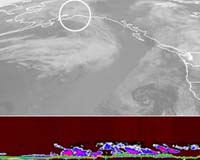
Washington DC (SPX) Jun 07, 2006 The first images from NASA's new CloudSat satellite already are revealing never-before-seen 3-D details about clouds. Mission managers tested the flight and ground system performance of the satellite's Cloud-Profiling Radar in late May, and they found it to be working perfectly. "CloudSat's radar performed flawlessly, and although the data are still very preliminary, it provided breathtaking new views of the weather on our planet," said Graeme Stephens, CloudSat's principal investigator. He said the satellite has observed all major cloud system types, and its radar demonstrated an ability to penetrate through almost all but the heaviest rainfall. "We have now begun continuous radar operations, and we look forward to releasing our first validated data to the science community within nine months, hopefully sooner," Stephens said. Just 30 seconds after radar activation, CloudSat obtained its first image: a slice of the atmosphere from the top to the surface of a warm storm front over the North Sea in the North Atlantic approaching Greenland. Unlike other satellite observations, the CloudSat radar image shows the storm's clouds and precipitation simultaneously. The front's warm air can be seen rising over colder air, with precipitation below. The remaining orbits of the test recorded unique observations of other weather types on a scale never seen before. The radar obtained first-time observations of clouds and snow storms over the Antarctic. Until now, clouds have been hard to observe in polar regions using satellite remote sensing, particularly during the polar night season. The CloudSat observations also provided new views of sloping, frontal clouds and thunderstorms over Africa, both as individual storms and as part of larger tropical storm systems. "We're seeing the atmosphere as we've never seen it before," said Deborah Vane, CloudSat's deputy principal investigator at NASA's Jet Propulsion Laboratory in Pasadena, Calif. "We're no longer looking at clouds like images on a flat piece of paper, but instead we're peering into the clouds and seeing their layered complexity." The first-ever millimeter wavelength radar, CloudSat's Cloud-Profiling Radar is more than 1,000 times more sensitive than typical weather radar. It can observe clouds and precipitation in a way never before possible, distinguishing between cloud particles and precipitation. Its measurements are expected to offer new insights into how fresh water is created from water vapor and how much of this water falls to the surface as rain and snow. CloudSat was launched April 28 from Vandenberg Air Force Base, Calif., along with NASA's Cloud-Aerosol Lidar and Infrared Pathfinder Satellite Observations satellite, also known as CALIPSO. Both satellites will orbit 438 miles above Earth aboard NASA's "A-Train" constellation of five Earth Observing System satellites. The A-Train satellites will work together to provide new insights into the global distribution and evolution of clouds to improve weather forecasting and climate prediction. CloudSat is managed by JPL, which developed the radar instrument with hardware contributions from the Canadian Space Agency. Colorado State University provides scientific leadership and science data processing and distribution. Ball Aerospace and Technologies Corp., in Boulder, Colo., designed and built the spacecraft. The U.S. Air Force and U.S. Department of Energy contributed resources. U.S. and international universities and research centers support the mission science team. Community Email This Article Comment On This Article Related Links CloudSat Earth Observation News - Suppiliers, Technology and Application
 UAE To Monitor Construction Sites Via Satellite
 Dubai (AFP) Jun 07, 2006
The UAE labour ministry will soon use high-resolution satellite imagery to monitor the country's big construction projects which have been the scene of several riots, newspapers reported Monday. |
|
|

| The content herein, unless otherwise known to be public domain, are Copyright 1995-2006 - SpaceDaily.AFP and UPI Wire Stories are copyright Agence France-Presse and United Press International. ESA PortalReports are copyright European Space Agency. All NASA sourced material is public domain. Additionalcopyrights may apply in whole or part to other bona fide parties. Advertising does not imply endorsement,agreement or approval of any opinions, statements or information provided by SpaceDaily on any Web page published or hosted by SpaceDaily. Privacy Statement |