|
 |
 |
 |
 |
 |
 |
 |
 |

 |
First China-Russia War Games End But Future Drills Mulled
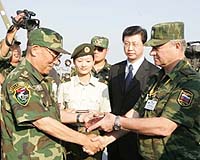
Beijing (AFP) Aug 25, 2005 Elite soldiers from China and Russia staged a mock airborne attack Thursday as unprecedented joint military exercises wrapped up amid suggestions that they would not be the last, state media reported. Russian Defense Minister Sergei Ivanov, who flew in for the last stage of the eight-day "Peace Mission 2005" maneuver, said new drills may take place in the future, Xinhua news agency reported. "Only when we are closely united can we meet new challenges and threats," Ivanov was quoted as saying by Xinhua news agency, reporting from the exercise area in east China's Shandong province. Ivanov argued the friendship of China's and Russia's armed forces would become a major guarantee for peace in the Asia-Pacific region and the world as a whole, according to the agency. Washington, which has indicated unease over the pace of China's military build-up, is not attending as an observer but has said it is closely monitoring the drills. Earlier Thursday, 86 Chinese and Russian shock troops parachuted into battle on a firing range near the city of Weifang. "Although the enemy troops still put up a desperate struggle, their failure had become a foregone conclusion," Xinhua said of the drill. Xinhua did not specify who the enemy was supposed to be, but China's airborne units are believed to be training almost exclusively to be ready to strike Taiwan if called upon to do so. Ivanov, his Chinese counterpart Cao Gangchuan and senior defense officials from Central Asia were observing the drill, which has involved nearly 10,000 officers and men, the news agency said. Observers have said the last few days of exercise were mostly for show, as several of the participating units have been practicing in the area for weeks to avoid glitches while the top brass was watching. But it has also been an opportunity for China to see Russia's battle-hardened soldiers in action and learn from them. For Thursday's airborne assault, the Russian side contributed a reinforced company from the 76th Division, a unit with extensive experience fighting in Chechnya, according to Russia's Itar-Tass news agency. The maneuvers saw the deployment of Beriev/Ilyushin A-50 early warning aircraft from the Russian military, Xinhua said. Some observers see this as significant as China is reported to have sought to buy this aircraft from Russia after a planned purchase of a similar Israeli plane failed to materialize, reportedly over US objections. China is believed to be actively pursuing improved early warning capabilities to boost its power in the air and improve its own chances of winning a war in the Taiwan Straits. Over the past week, primetime TV news in China has been showing dramatic footage from the war games, which began in Russia's Pacific port city of Vladivostok and later moved to China's east coast. Images of landing craft moving ashore with blazing guns while helicopter gunships pulverized beach defenses have been interpreted as a clear warning to Taiwan, the independence-minded island China claims as its own. Russian media have said China paid for the entire exercise, reflecting the high value attached to it by Beijing. For Russia, by contrast, the drill has been more about making money, with the maneuvers considered as a sales pitch for the country's cash-starved defense industries. With sales of up to three billion dollars a year, Russia has supplied 85 percent of China's arms imports since the early 1990s, according to the Pentagon. It is an extra incentive for Russia that the European Union may be about to lift an arms embargo against China, according to reports. "If the embargo would be lifted, then Russia would receive serious competitors in the Chinese arms market so far dominated by Moscow," the Russian paper Kommersant said in an editorial in its English-language online edition. "For that reason, the maneuvers should persuade the Chinese that the Russian arms are the most reliable and the cheapest in the world and they should keep using them." Community Email This Article Comment On This Article Related Links SpaceDaily Search SpaceDaily Subscribe To SpaceDaily Express Learn about the Superpowers of the 21st Century at SpaceWar.com Learn about nuclear weapons doctrine and defense at SpaceWar.com
 China Wants To Boost Trade, Military Ties With India
 Kuala Lumpur (AFP) Dec 14, 2005
China on Wednesday said its level of trade with India was too low and pressed for more cooperation between the world's two largest developing nations. |
|
|

| The content herein, unless otherwise known to be public domain, are Copyright 1995-2006 - SpaceDaily.AFP and UPI Wire Stories are copyright Agence France-Presse and United Press International. ESA PortalReports are copyright European Space Agency. All NASA sourced material is public domain. Additionalcopyrights may apply in whole or part to other bona fide parties. Advertising does not imply endorsement,agreement or approval of any opinions, statements or information provided by SpaceDaily on any Web page published or hosted by SpaceDaily. Privacy Statement |