|
 |
 |
 |
 |
 |
 |
 |
 |

 |
First-Of-Its-Kind Experiment On San Andreas
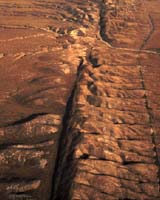
Houston TX (SPX) Sep 08, 2004 Using classified technology developed by the military during the Cold War, a team of geoscientists led by Rice University's Manik Talwani is conducting a first-of-its-kind experiment on California's famed San Andreas fault this week. The researchers will gather data that could give scientists a much clearer picture of the fault's "gouge zone," a region 2-3 kilometers beneath the earth consisting of gravel-sized rock that is created when continental plates grind against one another. Little data has been collected on the deep underlying structures of fault lines because it's very expensive to drill deep wells and install instruments that far below ground. This week's experiments take advantage of extremely sensitive gravity instruments that will be flown over the site in an airplane. By taking to the air, Talwani and his colleagues will be able to cover a 100-square kilometer region of the San Andreas near the town of Parkfield, in central California. "If this technique works, it will open the door for geoscientists to affordably gather information about fault lines and other subsurface areas of interest," said Talwani, the Schlumberger Professor of Geophysics. "Moreover, these flights will give us a baseline measurement that we can compare with future surveys to find out how things are changing in the shallow crust beneath the surface of the fault." The experiments take advantage of the fact that gravity varies slightly over the Earth's surface, due to small changes in the mass of subsurface rock and sediments. Using sophisticated instruments developed for nuclear submarines during the Cold War, the research team will measure the gravity gradient, or the rate at which gravity changes from place to place along the San Andreas. The flights are being conducted near Parkfield, because that is the site of the International Continental Drilling project, a scientific mission that's taking core samples within the region that Talwani's team is measuring. This physical evidence will help Talwani's team as it analyzes its data. Ultimately, Talwani hopes the technology will change the economics of studying fault lines by making it affordable to conduct baseline and follow-up surveys of significant portions of fault lines - something that just isn't cost effective with land-based instruments. The gravity gradiometer that's being used this week was developed at great expense by Lockheed-Martin during the Cold War. It was originally developed as a silent navigation system for nuclear submarines, and some of the underlying technology of the instrument remains classified. Talwani's group is contracting with the Houston-based Bell Geospace to carry out the airborne gradiometer survey. The project is supported by the National Science Foundation, the National Imagery and Mapping Agency and several industrial firms. Community Email This Article Comment On This Article Related Links Rice University Bell Geospace SpaceDaily Search SpaceDaily Subscribe To SpaceDaily Express Tectonic Science and News
 Ash Continuing To Spew From Vanuatu Volcano
 Sydney (AFP) Dec 12, 2005
Thousands of tonnes of ash are continuing to spew from a volcano in Vanuatu, but officials said Monday the activity on the South Pacific nation was not likely to result in a major deadly eruption. |
|
|

| The content herein, unless otherwise known to be public domain, are Copyright 1995-2006 - SpaceDaily.AFP and UPI Wire Stories are copyright Agence France-Presse and United Press International. ESA PortalReports are copyright European Space Agency. All NASA sourced material is public domain. Additionalcopyrights may apply in whole or part to other bona fide parties. Advertising does not imply endorsement,agreement or approval of any opinions, statements or information provided by SpaceDaily on any Web page published or hosted by SpaceDaily. Privacy Statement |