|
 |
 |
 |
 |
 |
 |
 |
 |

 |
Fire On The Vomit Comet
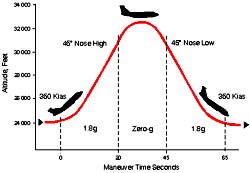
Park Campus CA (SPX) Jul 16, 2004 Tiny pellets of fuel may be safer for hazardous places on earth and burn more efficiently in weightless space and low-gravity environments. Researchers from the USC Viterbi School of Engineering say solid fuel particles may be safer for hazardous environments on earth and burn more efficiently in the microgravity of space than gaseous fuels, which are more combustible and difficult to transport. In the Spring 2004 issue of NASA Space Research, Fokion Egolfopoulos and Charles Campbell, of the Viterbi School�s Department of Aerospace and Mechanical Engineering, report that they have made significant progress toward understanding the complex chemical processes that take place when tiny particles of solid fuels burn. Their findings could lead to the design of safer and more efficient solid fuels for propulsion in space or for maintaining human outposts on the moon or Mars. Their research could also benefit fire-prevention practices. "Understanding the thermal effects is a first step toward improving fuel economy in both space vehicles and those we use on Earth," said Egolfopoulos. "It�s also a good start towards preventing spontaneous combustion in dangerous work environments, like in lumber milling, in grain elevators or in mine galleries. It's a sort of walk-before-you-run kind of thing." Funded by NASA, the researchers made detailed studies of solid fuel combustion, including the effects of gravity on the process. They measured the burning characteristics of various solid fuel particles on earth and in microgravity, using NASA�s KC-135 aircraft - known as the "Vomit Comet" - to simulate the weightlessness of space. "It takes some getting used to, but after a while, you learn to conduct the experiment very precisely," said Mustafa Gurhan Andac, a post-doctoral research associate from the Viterbi School's Combustion and Fuels Laboratory, who ran the experiments in the nearly weightless environment aboard the NASA aircraft. "You only have about 23 seconds in zero-g, so you have to ignite the flame before the zero-g parabola starts and be sure to finish the experiment and record the data during those precious seconds of weightlessness." In their experiments, the team used two laminar, smooth-burning flames in an "opposed-jet" configuration to compare the consumption of solid fuel and gaseous fuel. The bottom burner slowly spews gas to carry solid fuel pellets to the flame, while the top burner issues particle-free gas to fuel the flame. "Depending on the prevailing flow conditions, and characteristics of the particles, some particles will ignite and burn completely, whereas others behave as half-inert and burn only partially," Egolfopoulos said. The researchers measured particle size, speed and distribution to determine the optimal conditions for efficient combustion. "In reduced gravity, a low-speed gas was more effective for complete fuel consumption," said Campbell. "However, when we ignited the pellets in our laboratory at USC, in earth�s gravity, a much higher gas velocity was needed to carry the pellets to the flame. Increased speed caused some of the fuel pellets to burn incompletely." NASA is finding additional applications for the work as the space agency looks to longer spaceflight missions and human exploration of the moon and Mars. In trips to the moon or Mars, solid fuels derived from the lunar or Martian soil, or solid carbon, extracted from the Martian atmosphere, may fuel the astronauts' return flights to Earth. The researchers have created a computational model to numerically simulate their experiments and predict the combustion of solid fuel particles in a gaseous stream, based on thermal conditions and particle properties. They will present their findings, and a few surprises, at the 30th International Symposium on Combustion, to be held July 25-30 in Chicago, Illinois. Community Email This Article Comment On This Article Related Links USC Viterbi School of Engineering Combustion 2004 in Illinois SpaceDaily Search SpaceDaily Subscribe To SpaceDaily Express Rocket Science News at Space-Travel.Com
 Falcon 1 To Launch February 8
 Kwajalein Atoll, Marshall Islands (SPX) Jan 11, 2006
The new launch time for Space X's maiden launch of its Falcon 1 rocket is February 8, at 4:30 p.m. California time, with Feb. 9 as a backup day. We will actually be ready to launch earlier, but are planning to spend extra time reviewing and double-checking all vehicle systems. |
|
|

| The content herein, unless otherwise known to be public domain, are Copyright 1995-2006 - SpaceDaily.AFP and UPI Wire Stories are copyright Agence France-Presse and United Press International. ESA PortalReports are copyright European Space Agency. All NASA sourced material is public domain. Additionalcopyrights may apply in whole or part to other bona fide parties. Advertising does not imply endorsement,agreement or approval of any opinions, statements or information provided by SpaceDaily on any Web page published or hosted by SpaceDaily. Privacy Statement |