
 |
 |
 |
 |
 |
 |
 |
 |
 |

 |
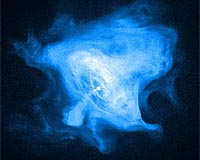
Fingers, Loops And Bays In The Crab Nebula
Boston MA (SPX) Nov 06, 2008 This image gives the first clear view of the faint boundary of the Crab Nebula's X-ray-emitting pulsar wind nebula. The nebula is powered by a rapidly-rotating, highly-magnetized neutron star, or "pulsar" (white dot near the center). The combination of rapid rotating and strong magnetic field generates an intense electromagnetic field that creates jets of matter and anti-matter moving away from the north and south poles of the pulsar, and an intense wind flowing out in the equatorial direction. The inner X-ray ring is thought to be a shock wave that marks the boundary between the surrounding nebula and the flow of matter and antimatter particles from the pulsar. Energetic electrons and positrons (antielectrons) move outward from this ring to brighten the outer ring and produce an extended X-ray glow. The fingers, loops, and bays in the image all indicate that the magnetic field of the nebula and filaments of cooler matter are controlling the motion of the electrons and positrons. The particles can move rapidly along the magnetic field and travel several light years before radiating away their energy. In contrast, they move much more slowly perpendicular to the magnetic field, and travel only a short distance before losing their energy. This effect can explain the long, thin, fingers and loops, as well as the sharp boundaries of the bays. The conspicuous dark bays on the lower right and left are likely due to the effects of a toroidal magnetic field that is a relic of the progenitor star. Community Email This Article Comment On This Article Share This Article With Planet Earth
Related Links NASA Chandra Astronomy News from Skynightly.com
 Hong Kong Space Museum Announces Refurbishment Project
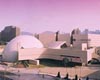 Hong Kong (XNA) Oct 29, 2008
The Hong Kong Space Museum Tuesday announced that a 34 million HK dollars (about 4.4 million US dollars) renovation project will be carried out at its Space Theater. |
|
|

| The content herein, unless otherwise known to be public domain, are Copyright 1995-2007 - SpaceDaily.AFP and UPI Wire Stories are copyright Agence France-Presse and United Press International. ESA Portal Reports are copyright European Space Agency. All NASA sourced material is public domain. Additional copyrights may apply in whole or part to other bona fide parties. Advertising does not imply endorsement,agreement or approval of any opinions, statements or information provided by SpaceDaily on any Web page published or hosted by SpaceDaily. Privacy Statement |
 del.icio.us
 Digg
Digg Reddit
 YahooMyWeb
 Google
 Facebook