|
 |
 |
 |
 |
 |
 |
 |
 |

 |
Findings By Scripps Scientists Cast New Light On Undersea Volcanoes
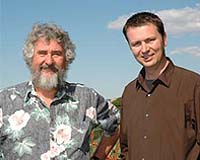
San Diego CA (SPX) Feb 14, 2005 Researchers at Scripps Institution of Oceanography at the University of California, San Diego, have produced new findings that may help alter commonly held beliefs about how chains of undersea mountains formed by volcanoes, or "seamounts," are created. Such mountains can rise thousands of feet off the ocean floor in chains that span thousands of miles across the ocean. Since the mid-20th century, the belief that the earth's surface is covered by large, shifting plates - a concept known as plate tectonics - has shaped conventional thinking on how seamount chains develop. Textbooks have taught students that seamount patterns are shaped by changes in the direction and motion of the plates. As a plate moves, stationary "hot spots" below the plate produce magma that forms a series of volcanoes in the direction of the plate motion. Now, Anthony Koppers and Hubert Staudigel of Scripps have published a study that counters the idea that hot spots exist in fixed positions. The paper in the Feb. 11 issue of Science shows that hot spot chains can change direction as a result of processes unrelated to plate motion. The new research adds further to current scientific debates on hot spots and provides information for a better understanding of the dynamics of the earth's interior. To investigate this phenomenon, Staudigel led a research cruise in 1999 aboard the Scripps research vessel Melville to the Pacific Ocean's Gilbert Ridge and Tokelau Seamounts near the international date line, a few hundred miles north of American Samoa and just south of the Marshall Islands. Gilbert and Tokelau are the only seamount trails in the Pacific that bend in sharp, 60-degree angles - comparable in appearance to hockey sticks - similar to the bending pattern of the Hawaii-Emperor seamount chain (which includes the Hawaiian Islands). Assuming that these three chains were created by fixed hot spots, the bends in the Gilbert Ridge and Tokelau Seamounts should have been created at roughly the same time period as the bend in the Hawaii-Emperor chain, the conventional theory holds. Koppers, Staudigel and a team of student researchers aboard Melville spent six weeks exploring the ocean floor at Gilbert and Tokelau. They used deep-sea dredges to collect volcanic rock samples from the area. For the next several years, Koppers used laboratory instruments to analyze the composition of the rock samples and calculate their ages. "It was quite a surprise that we found the Gilbert and Tokelau seamount bends to have completely different ages than we expected," said Koppers, a researcher at the Cecil H. and Ida M. Green Institute of Geophysics and Planetary Physics at Scripps. "We certainly didn't expect that they were 10 and 20 million years older than previously thought." Instead of forming 47 million years ago, as did the Hawaiian-Emperor bend, the Gilbert chain was found to be 67 million years old and the Tokelau 57 million years old. "I think this really hammers it in that the origin of the alignment of these seamount chains may be much more complicated than we previously believed, or the alignment may not have anything to do with plate motion changes," said Staudigel. Although they do not have positive proof as yet, Koppers and Staudigel speculate that local stretching of the plate may allow magma to rise to the surface or that hot spots themselves might move. Together with plate motion, these alternate processes may be responsible for the resulting pattern of seamounts. Koppers and Staudigel will go to sea again next year to seek additional clues to the hot spot and seamount mysteries. "Seamount trails are thousands of kilometers long and even if we are out collecting for several weeks, we still only cover a limited area," said Koppers. "One of the things holding us back in developing a new theory is that the oceans are humongous and our database is currently very small we are trying to understand a very big concept." Community Email This Article Comment On This Article Related Links SpaceDaily Search SpaceDaily Subscribe To SpaceDaily Express Tectonic Science and News
 Ash Continuing To Spew From Vanuatu Volcano
 Sydney (AFP) Dec 12, 2005
Thousands of tonnes of ash are continuing to spew from a volcano in Vanuatu, but officials said Monday the activity on the South Pacific nation was not likely to result in a major deadly eruption. |
|
|

| The content herein, unless otherwise known to be public domain, are Copyright 1995-2006 - SpaceDaily.AFP and UPI Wire Stories are copyright Agence France-Presse and United Press International. ESA PortalReports are copyright European Space Agency. All NASA sourced material is public domain. Additionalcopyrights may apply in whole or part to other bona fide parties. Advertising does not imply endorsement,agreement or approval of any opinions, statements or information provided by SpaceDaily on any Web page published or hosted by SpaceDaily. Privacy Statement |