|
 |
 |
 |
 |
 |
 |
 |
 |

 |
Finding Advances Quantum Computing
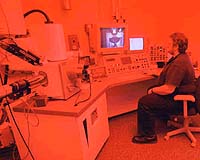
Madison - Jul 26, 2002 Material scientists at the University of Wisconsin at Madison have built a semiconductor based device that can trap individual electrons and line them up, an advance that could bring quantum computing out of the gee-whiz world of scientific novelty and into the practical realm. Led by physics professor Mark Eriksson, a team of physicists, materials scientists and engineers has developed a new type of "quantum dot" device for holding electrons that can be scaled up to build a working quantum computer. Made from tiny amounts of the same semiconductor materials used in today's computer chips, each quantum dot device contains just one infinitesimally small electron. When many of the devices are aligned, the electrons they house become usable quantum bits, or qubits, for computing. "The first prerequisite to building a large computer is to have a lot of bits, and we think we have a way to get a lot of them," says Eriksson. "We've done some sophisticated simulations with this device that show the concept is very likely to work, and we're in the beginning stages of actually making the device." Unlike the bits of classical, serial computers, which exist in either the 0 or 1 state, qubits can exist in more than one state at once. This elusive quality of their components frees quantum computers to calculate all the possible solutions to a problem simultaneously, instead of running through them one-by-one like their slower, serial counterparts. This ability to "parallel process" means quantum computers hold tremendous number-crunching potential for certain tasks -- such as highly sophisticated data encryption and code-breaking -- that now defy even the most powerful computers. The team's device uses layers of semiconductor materials and electrostatic forces -- the same forces that build up when you scuff across a carpet in winter -- to squeeze a single electron into place within each quantum dot. The design allows the alignment of a large number of dots, their captured electrons separated by a distance only one-one thousandth the width of a human hair. Eriksson emphasizes that researchers worldwide are trying to find the best way to harness subatomic particles for quantum computing. In fact, others have realized success in stringing a few quantum dots together. "People often talk about quantum computing in the future tense, but that's not really right -- it exists today. People have solved simple problems with it, but in the future we want to address problems that can't be solved by any other means," says Eriksson. With its potential for coupling hundreds of electrons, Eriksson believes the team's device could provide a quantum leap in that direction. "Our invention makes it more likely that quantum computing might actually be useful someday instead of a curiosity," he says. Eriksson's collaborators include physicist Robert Joynt, materials scientist Max Lagally, and electrical and computer engineer Daniel van der Weide. A patent on the technology has been filed by the Wisconsin Alumni Research Foundation, a non-profit organization that manages the intellectual property of the UW-Madison. Community Email This Article Comment On This Article Related Links Mark Eriksson's Research at Wisconsin-Madison Wisconsin Alumni Research Foundation SpaceDaily Search SpaceDaily Subscribe To SpaceDaily Express Space Technology News - Applications and Research
 Industry Team Achieve New Communications Technology With AESA Radars
 Baltimore MD (SPX) Jan 12, 2006
A team comprised of three leading US aerospace and defense contractors has demonstrated an innovative technological use of active electronically scanned array (AESA) radars for high-bandwidth communications. |
|
|

| The content herein, unless otherwise known to be public domain, are Copyright 1995-2006 - SpaceDaily.AFP and UPI Wire Stories are copyright Agence France-Presse and United Press International. ESA PortalReports are copyright European Space Agency. All NASA sourced material is public domain. Additionalcopyrights may apply in whole or part to other bona fide parties. Advertising does not imply endorsement,agreement or approval of any opinions, statements or information provided by SpaceDaily on any Web page published or hosted by SpaceDaily. Privacy Statement |