Energy News  
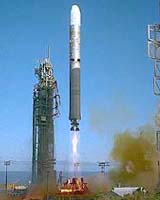
Final Refurbished Titan II Missile Launches Defense Weather Bird

DMSP, operated by the National Oceanic and Atmospheric Administration (NOAA), is used for strategic and tactical weather prediction to aid the U.S. military in planning operations at sea, on land and in the air.

Vandenberg AFB - Oct 19, 2003
A Lockheed Martin-built Titan II launch vehicle successfully placed the Defense Meteorological Satellite Program (DMSP) Block 5D-3 spacecraft into orbit this morning for the U.S. Air Force. The Titan II lifted off at 9:17 a.m. Pacific Daylight Time from Space Launch Complex 4West at Vandenberg Air Force Base, Calif. DMSP will be used for strategic and tactical weather prediction to aid the U.S. military in planning operations at sea, on land and in the air.

This launch marked the end of an era for the Lockheed Martin Titan team as the final refurbished intercontinental ballistic missile (ICBM) -- dubbed Titan II -- flew a perfect mission, capping an overall success record of 100 percent.

"Everyone at Lockheed Martin who has ever been a part of the Titan program watched with pride this morning as we launched another important space asset for our military forces," said G. Thomas Marsh, executive vice president of Lockheed Martin Space Systems Company.

"The Titan II program has been an outstanding example of partnership between the Air Force and Lockheed Martin, and we are very proud to fly the final rocket successfully and round out a perfect Titan II record."

Titan II ICBMs served as the vanguard of the United States' strategic deterrent for more than two decades. In the late 1960s, 10 Titan IIs also successfully launched astronauts as part of the Gemini program.

When the Titan II ICBMs were decommissioned, the U.S. Air Force Space and Missile Systems Center, Los Angeles, Calif., contracted with Lockheed Martin to refurbish 14 for use as space launch vehicles. Today's mission marked the 13th consecutive successful Titan launch. There are no current plans to launch the 14th vehicle.


Community
Email This Article
Comment On This Article

Related Links
Defense Meteorological Satellite Program
Lockheed Martin
SpaceDaily
Search SpaceDaily
Subscribe To SpaceDaily Express
Military Space News at SpaceWar.com


Memory Foam Mattress Review
Newsletters :: SpaceDaily :: SpaceWar :: TerraDaily :: Energy Daily
XML Feeds :: Space News :: Earth News :: War News :: Solar Energy News


Space Group To Activate New Unit
Colorado Springs CO (SPX) Jan 6, 2006
Air Force Reserve Command's 310th Space Group will travel deeper into the space program when it activates a new unit Jan. 7. Headquarters Reserve National Security Space Institute will be a Reserve associate unit to the National Security Space Institute in Colorado Springs, Colo. The institute is the Department of Defense's focal point for providing education about space power in joint warfighting.


  • MTI and Harris Further Develop Micro Fuel Cells for Military
  • China Bans Coal-Fire Power Plants In Major Cities
  • Dupont And NREL To Develop World's First Integrated Bio-Refinery
  • NASA Technology Reduces Some Smokestack Emissions

  • New Jersey Physicist Uncovers New Information About Plutonium
  • Complex Plant Design Goes Virtual To Save Time And Money
  • Volcanic Hazard At Yucca Mountain Greater Than Previously Thought
  • Los Alamos Lab Working On Romanian Nuke Waste Site


  • NASA Uses Remotely Piloted Airplane To Monitor Grapes


  • Wright Flyer Takes To The Sky In Las Vegas
  • Aurora Builds Low-speed Wind Tunnel
  • Yeager To Retire From Military Flying After October Airshow
  • Boeing Signs Technology Development Agreement With JAI For Work On Sonic Cruiser

  • Boeing Selects Leader for Nuclear Space Systems Program
  • Boeing-Led Team to Study Nuclear-Powered Space Systems
  • Boeing To Build Space-borne Power Generator
  • New High-Purity Plutonium Sources Produced At Los Alamos

  • The content herein, unless otherwise known to be public domain, are Copyright 1995-2006 - SpaceDaily.AFP and UPI Wire Stories are copyright Agence France-Presse and United Press International. ESA PortalReports are copyright European Space Agency. All NASA sourced material is public domain. Additionalcopyrights may apply in whole or part to other bona fide parties. Advertising does not imply endorsement,agreement or approval of any opinions, statements or information provided by SpaceDaily on any Web page published or hosted by SpaceDaily. Privacy Statement