|
 |
 |
 |
 |
 |
 |
 |
 |

 |
Ferry-Linked Water Monitoring System Becomes New Model For United States
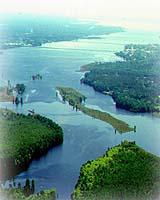
Chapel Hill NC (SPX) Jul 18, 2005 University of North Carolina at Chapel Hill and Duke University marine scientists who began monitoring surface water quality in the Neuse River in 2000 say their expanded effort has become a model for continuous ferry-based water assays throughout the nation. Help and support from the N.C. Department of Transportation's Division of Ferries and Department of Environment and Natural Resources (DENR) deserves much of the credit, the researchers say. Drs. Hans Paerl and Joseph S. Ramus, professors at the UNC-Chapel Hill and Duke marine laboratories in Morehead City and Beaufort, respectively, and project co-directors, added water quality monitoring to the Swan Quarter-Ocracoke and Cedar Island-Ocracoke ferries in 2001. Their automated project, called FerryMon, keeps watch over and helps protect the unique Pamlico Sound. Since then, marine scientists in Florida, Massachusetts, Maine and New York and as far away as San Francisco Bay and Washington's Puget Sound have begun designing, and in some cases already using, comparable systems, said Paerl, William R. Kenan professor at UNC's Institute of Marine Sciences. "This effort, which we see as vital, has been working flawlessly, and we can't say enough about how helpful the people with the N.C. DOT's ferry division and DENR have been," Paerl said. "The monitoring has been especially helpful in keeping state policymakers and scientists informed about what has happened in Pamlico Sound following the recent increase in hurricanes." Hurricanes Floyd, Dennis and Irene in 1999 stimulated the state's interest in supporting the research, although Ramus and he began planning the system three years before that, Paerl said. Critical to understanding the state's coastal ecology is reliable information about human-related changes in water quality, the impact of nutrients flowing into eastern waters, development, pollution, sedimentation and pressures on the shellfish and fin fish industries, which often are overlooked. Pamlico Sound, the nation's second largest sound, has "held the distinction of being the largest estuary in the United States about which least is known," Ramus said. "Our program now forms the basis for evaluating and modeling how its ecosystem responds to human and natural impacts." Endeco/YSI of Marion, Mass., built the FerryMon equipment, which is the most sophisticated of its kind in the world, the scientists said. That instrumentation sits in a box attached to a water intake line in each ferry's protected sea chest below deck and amidships. Some of the water, needed to cool the ships' air conditioning machinery, is first diverted to devices that record temperature, salinity, pH, dissolved oxygen, chlorophyll and geographic position once a minute. A telemetry system involving cell phones enables researchers to collect data at their laboratories for analysis anytime they wish. Another automated, carousel-like refrigerated device collects water samples to be tested for nutrients, algal pigments, harmful bacteria, dissolved organic matter and suspended solids that cause turbidity. "The frequency of data collection ensures that we have all-important information on where and when samples were gathered and tested," Ramus said. "We're also able to study daily, seasonal and yearly variations, cycles and trends and also compare those with effects of weather on algal productivity. All data is being archived in digital form for further analysis." Goals include learning how excessive naturally produced nutrients and those resulting from agriculture, industry, municipalities and domestic sources affect the environment and providing information needed for long-term water quality management. "The Neuse River ferry first showed its value in enabling us to get a comprehensive, integrated view of the river," Paerl said. "That's important because events that occur there, like fish kills and low oxygen, may happen at sites across the estuary that may not be covered by routine monitoring at restricted locations. Trying to establish cause and effect relationships between changes in water quality and those events has been one of the more frustrating aspects of understanding how complex estuarine environments work." "Hardly anything ever functions the first time you try it, but in this case, it started spitting out data as soon as we turned it on," Paerl said. "It provided the first continuing, comprehensive view of water quality in Pamlico Sound." A major advantage is cost savings resulting from placing the equipment aboard the ferries, he said. The project operates on about $300,000 a year, which the two scientists say is a real bargain. "When you look at the cost of doing oceanographic survey work for water quality, even if it's just in a lake, more than 50 percent of the cost is just the vessel itself," the scientist said. "For us, that part is free." The recent rash of hurricanes hitting North Carolina, which are expected to continue, have been a wake-up call for state support of water quality monitoring, Ramus said. "Given the fact that there are predictions of several decades of elevated tropical storm activity, the timing couldn't be better for continuing to take a serious look at North Carolina's remarkable water resources in the east," he said. "Our state's previous commitment to FerryMon was a wise decision." Among the benefits of continued state support will be leveraging additional federal funding from such agencies as the EPA and the National Oceanic and Atmospheric Administration, Paerl said. Another is applying the latest technology for remote sensing to assess water quality over thousands of square miles. "For example, during the summers of 2002 and 2004, because FerryMon allowed calibration of aircraft-based optical instruments, the EPA and NASA targeted Pamlico Sound for large-scale assessments of water quality and marine habitat using a modified U2 reconnaissance plane," Paerl said. "Flights the aircraft made at an altitude of 12 miles enabled scientists to create maps of the amounts of nutrients and sediments in freshwater runoff entering the sound, and the algae responses, including potentially harmful 'blooms,' to these sources across most of Pamlico Sound." Community Email This Article Comment On This Article Related Links FerryMon University of North Carolina at Chapel Hill Duke University SpaceDaily Search SpaceDaily Subscribe To SpaceDaily Express Dirt, rocks and all the stuff we stand on firmly
 Environmental Damage Threatens Human Health
 Bangkok (AFP) Dec 9, 2005
Environmental damage threatens human health and may have contributed to the spread of new diseases like bird flu and SARS, the World Health Organization said in a report Friday. |
|
|

| The content herein, unless otherwise known to be public domain, are Copyright 1995-2006 - SpaceDaily.AFP and UPI Wire Stories are copyright Agence France-Presse and United Press International. ESA PortalReports are copyright European Space Agency. All NASA sourced material is public domain. Additionalcopyrights may apply in whole or part to other bona fide parties. Advertising does not imply endorsement,agreement or approval of any opinions, statements or information provided by SpaceDaily on any Web page published or hosted by SpaceDaily. Privacy Statement |