|
 |
 |
 |
 |
 |
 |
 |
 |

 |
Faulted Modeling
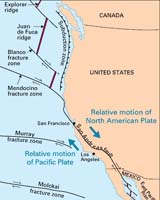
Virginia Key, FL (SPX) Mar 26, 2007 Factoring in crustal strength changes along the San Andreas Fault would improve the predictive models that researchers use to understand the likelihood and intensity of earthquakes there. That's the conclusion from a study published in the April issue of Geology titled, "Diffuse interseismic deformation across the Pacific-North America plate boundary." Currently, it is standard practice for universities and government agencies to measure crustal movement that occurs within Southern California using precise Global Positioning System (GPS) and other highly accurate tools that project movements in millimeters per year. In this study, Dr. Shimon Wdowinski, research associate professor at the University of Miami Rosenstiel School of Marine and Atmospheric Science, and scientists from Scripps Institution of Oceanography used 840 very precise measurements of crustal movements collected in the past 25 years. These measurements were conducted mainly in southern California, to study the nature of steady crustal movements occurring in between large earthquakes within this same zone. By using a geometrical technique, they found a disparity between the observations and a mechanical model in a narrow band along the San Andreas Fault and in the Mojave Block. "This suggests that crustal changes and fault segments that haven't yet been included in models really should be considered in future ones," Wdowinski said. "By adding in this information to the models, scientists will improve their assessments of potential earthquake hazards." The steady motion between the Pacific and North American tectonic plates deforms a wide region in the western United States, extending over California, Arizona, Nevada, and Utah. The San Andreas Fault absorbs most of the deformation. The deformation increases the stress level within the Earth's crust, mainly along fault segments. Once the stresses reach high enough values, which cannot be supported by the crust, that is when faulting occurs and the excess stress is released by an earthquake. Wdowinski conducted the research with Drs. Bridget Smith, Yehuda Bock, and David Sandwell from the Cecil H. and Ida M. Green Institute of Geophysics and Planetary Physics at Scripps Institution of Oceanography in La Jolla, Calif. Funding was provided via NOAA and NASA. Community Email This Article Comment On This Article Related Links Rosenstiel School When the Earth Quakes Tectonic Science and News
 The Next Great Earthquake
 Troy NY (SPX) Mar 26, 2007
The 2004 Sumatra-Andaman earthquake and resulting tsunami are now infamous for the damage they caused, but at the time many scientists believed this area was unlikely to create a quake of such magnitude. In the March 23 issue of the journal Science, a geophysicist from Rensselaer Polytechnic Institute urges the public and policy makers to consider all subduction-type tectonic boundaries to be "locked, loaded, and dangerous." |
|
|

| The content herein, unless otherwise known to be public domain, are Copyright 1995-2006 - SpaceDaily.AFP and UPI Wire Stories are copyright Agence France-Presse and United Press International. ESA PortalReports are copyright European Space Agency. All NASA sourced material is public domain. Additionalcopyrights may apply in whole or part to other bona fide parties. Advertising does not imply endorsement,agreement or approval of any opinions, statements or information provided by SpaceDaily on any Web page published or hosted by SpaceDaily. Privacy Statement |