|
 |
 |
 |
 |
 |
 |
 |
 |

 |
Faster Than a Speeding Bullet: Guinness Recognizes NASA Scramjet
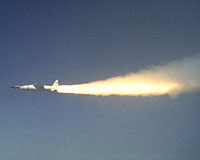
Edwards CA (SPX) Jun 21, 2005 NASA has been officially recognized for setting the speed record for a jet-powered aircraft by Guinness World Records. NASA set the record in November during the third and final flight of the experimental X-43A scramjet (supersonic-combustion ramjet) project. The X-43A demonstrated an advanced form of air-breathing jet engine could power an aircraft nearly 10 times the speed of sound. Data from the unpiloted, 12-foot-long research vehicle show its revolutionary engine worked successfully at Mach 9.6 (approximately 7,000 mph), as it flew over the Pacific Ocean west of California. The flight was the culmination of NASA's Hyper-X Program. Hyper-X, a seven-year, approximately $230 million ground and flight test program, explored alternatives to rocket power for space access vehicles. This is the second world speed record earned by the Hyper-X Program. The first followed a Mach 6.8 (approximately 5,000 mph) flight in March 2004. Both records will be featured in the 2006 edition of the Guinness World Records book published in September 2005. The fastest air-breathing, manned vehicle, the SR-71, achieved slightly more than Mach 3.2. The X-43A more than tripled the top speed of the jet-powered SR-71. NASA is interested in supersonic combustion scramjet technology, because the engines get their oxygen from the atmosphere. That allows for more airplane-like operations for increased affordability, flexibility and safety in ultra-high-speed flights and for the first stage to Earth orbit. Once a scramjet-powered vehicle is accelerated to approximately Mach 4 by a conventional jet engine or booster rocket, it can fly at hypersonic speeds, possibly as fast as Mach 15, without carrying heavy oxidizer, as rockets must. A ramjet operates by subsonic combustion of fuel in a stream of air compressed by the forward speed of the aircraft. In a regular jet engine, fan blades compress the air. In a scramjet, the airflow through the whole engine remains supersonic.
The Guinness World Record certificate "On 16 November, 2004, NASA's unmanned Hyper-X (X-43A) aircraft reached Mach 9.6. The X-43A was boosted to an altitude of 33,223 meters (109,000 feet) by a Pegasus rocket launched from beneath a B52-B jet aircraft. The revolutionary 'scramjet' aircraft then burned its engine for around 10 seconds during its flight over the Pacific Ocean."
Related flight records The previous record for an air-breathing vehicle, but not an airplane, was held by a ramjet-powered missile, which achieved slightly more than Mach 5. The highest speed attained by a rocket-powered airplane, NASA's X-15, was Mach 6.7. The Hyper-X program was conducted by NASA's Aeronautics Research Mission Directorate with the agency's Langley Research Center, Hampton, Va. Langley was lead NASA center with responsibility for hypersonic technology development. The NASA Dryden Flight Research Center, Edwards, Calif., is responsible for flight research and testing. Community Email This Article Comment On This Article Related Links NASA's Aeronautics Research Mission Directorate SpaceDaily Search SpaceDaily Subscribe To SpaceDaily Express Rocket Science News at Space-Travel.Com
 Successful First Test For Vega's Zefiro 9 Engine
 Paris, France(ESA) Dec 28, 2005
Flames, smoke and a deafening noise accompanied the first firing test of Vega's Zefiro 9 third-stage solid rocket motor. A first examination of the data indicates that everything went well at the test carried out yesterday at Salto de Quirra in southeast Sardinia. |
|
|

| The content herein, unless otherwise known to be public domain, are Copyright 1995-2006 - SpaceDaily.AFP and UPI Wire Stories are copyright Agence France-Presse and United Press International. ESA PortalReports are copyright European Space Agency. All NASA sourced material is public domain. Additionalcopyrights may apply in whole or part to other bona fide parties. Advertising does not imply endorsement,agreement or approval of any opinions, statements or information provided by SpaceDaily on any Web page published or hosted by SpaceDaily. Privacy Statement |