|
 |
 |
 |
 |
 |
 |
 |
 |

 |
Fasten Your Seat Belts, Turbulence Ahead - Lessons From Titan
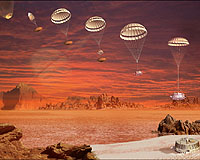
Reading, UK (SPX) Aug 29, 2007 Ever spilled your drink on an airline due to turbulence? Researchers on both sides of the Atlantic are finding new ways to understand the phenomenon - both in Earth's atmosphere and in that of Saturn's moon, Titan, aided by Huygens probe data. The study of one is helping the other. Turbulence plays an important role in Earth's weather system, and can be more than an inconvenience - hundreds of injuries have occurred on commercial flights due to turbulence. Giles Harrison, atmospheric physicist at the University of Reading in the United Kingdom, devised an inexpensive way to measure the effects of turbulence using weather balloons. The instrument package contains a magnetic field sensor which measures fluctuations in Earth's magnetic field due to turbulence. As Earth's magnetic field is very stable, the measurements of magnetic changes taken with the weather balloon showed the effects of turbulence on the sensor, since the balloon itself was moving very violently. All bodies, planets and moons, are subject to the same principles of physics. So by working together, researchers looking at Earth and those looking at our planetary neighbors can really test their models of the processes taking place and gain new insights into both. Planetary scientist Ralph Lorenz, at the Johns Hopkins University Applied Physics Laboratory in Baltimore, Md., found Harrison's results key to making sense of data from the European Space Agency's Huygens probe, which descended by parachute through Titan's atmosphere in January 2005. The Huygens probe was delivered to Titan aboard NASA's Cassini spacecraft. Cassini continues to orbit Saturn on a four-year prime mission to study the planet, its rings, moons and magnetosphere. The Surface Science Package onboard Huygens included a set of tilt sensors, which measured motions of the probe during its descent. These tilt sensors acted much like a drink in a glass, using a small slug of liquid to measure tilt angle. As the probe plummeted under the parachute through Titan's atmosphere, there was a lot of buffeting, even though the atmosphere itself was fairly still. Knowing the signature of cloud-induced turbulence in Harrison's balloon data from Earth inspired Lorenz to look for a similar effect in the Huygens data using the tilt sensor. "Huygens' tilt history was just this long, squiggly, complex mess, but seeing the fingerprint of cloud turbulence in Harrison's work showed me what to look for," said Lorenz. Armed with that information, Lorenz found that a 20-minute period of Huygens' 2.5-hour descent, around an altitude of 20 kilometers (12 miles), was affected by this kind of in-cloud turbulence. Having experimented with instrumentation on small models, even frisbees, to understand the dynamics of aerospace vehicles like the probe, Lorenz was familiar with the sensors used by Harrison. Lorenz's analysis helped identify a turbulent cloud layer in Titan's atmosphere - a significant result for the investigation of Titan's meteorology. In the process, he also found a way to improve Harrison's magnetic sensor arrangement on the weather balloon, simply by changing its orientation. Mark Leese, project manager for the Surface Science Package on Huygens at The Open University in the United Kingdom, said "We knew Huygens had a bumpy ride down to Titan's surface, now we can separate out 20 minutes of air turbulence ? probably due to a cloud layer - from other effects such as cross winds or air buffeting due to the irregular shape of the probe." Notes for editors: Lorenz's analysis, with co-authors J. Zarnecki, M. Towner, M. Leese, A. Ball, B. Hathi, A. Hagermann and N. Ghafoor, appears in the online version of the Planetary and Space Science journal. It is expected to appear in print in November. The original work by Harrison and Hogan was published last year in the Journal of Atmospheric and Oceanic Technology. An exchange of ideas between Lorenz and Harrison appears in the August 2007 issue of the Journal of Oceanic and Atmospheric Technology. Harrison's work is supported by the Paul Instrument Fund of the Royal Society. Lorenz is supported by NASA's Cassini Project. The Science and Technology Facilities Council funds UK participation in the Cassini Huygens mission, in particular, the research at The Open University. Weather balloons carry measuring packages known as radiosondes, which make measurements (soundings) of air temperature, moisture and wind direction used for weather forecasting. The balloons are filled with helium or hydrogen gas and the measurements are sent back to the surface by radio. When the balloon bursts, usually at 15 to 20 kilometers (9.3 to 12.4 miles) altitude, the instruments fall to Earth by parachute. The Cassini-Huygens mission is a cooperative project of NASA, the European Space Agency and the Italian Space Agency. The Jet Propulsion Laboratory, a division of the California Institute of Technology in Pasadena, manages the Cassini-Huygens mission for NASA's Science Mission Directorate, Washington. JPL designed and assembled the Cassini orbiter. Development of the Huygens Titan probe was managed by the European Space Agency's European Space Technology and Research Center. The Italian Space Agency managed the realization of the high-gain antenna and the other instruments of its participation. Community Email This Article Comment On This Article Related Links Explore The Ring World of Saturn and her moons Jupiter and its Moons The million outer planets of a star called Sol News Flash at Mercury
 Cassini Saturn Team From America And Europe Plan Flyby Of Saturn Moon Enceladus
 Washington (USINFO) Aug 05, 2007
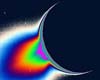
The science team for the international Cassini mission to Saturn is planning to modify the 2008 flyby of Enceladus, one of the ringed planet's innermost moons, to send the spacecraft through a watery geyser rising from the moon's surface. The Cassini mission is a joint effort of NASA, the European Space Agency and Agenzia Spaziale Italiana, the Italian space agency. |
|
|

| The content herein, unless otherwise known to be public domain, are Copyright 1995-2007 - SpaceDaily.AFP and UPI Wire Stories are copyright Agence France-Presse and United Press International. ESA Portal Reports are copyright European Space Agency. All NASA sourced material is public domain. Additional copyrights may apply in whole or part to other bona fide parties. Advertising does not imply endorsement,agreement or approval of any opinions, statements or information provided by SpaceDaily on any Web page published or hosted by SpaceDaily. Privacy Statement |