|
 |
 |
 |
 |
 |
 |
 |
 |

 |
Fast Track For Innovative Space Technologies
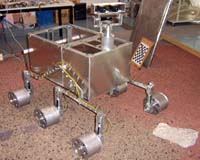
Paris, France (ESA) Dec 28, 2005 A novel astronaut training system, innovative planetary landing technology and hydrogen gas storage in 0.1-mm micro-spheres are just some of the innovative ideas presented during the first Innovation Triangle Initiative (ITI) Final Presentation Day (FPD) at ESTEC. Stephane Lascar, Head of ESA's Technology Harmonisation and Strategy Division, opened the ITI FPD event: "We received more than 200 proposals of which 37 were selected and kicked-off. After 18 months of work 16 have now been concluded with good results and will be presented today." Marco Guglielmi, head of ESA's Technology Strategy Section and one of the founders of ITI, added: "The results obtained confirm that the ITI concept works, combining the three entities involved - the innovator, the developer and the end-user - for fast validation of new ideas for space technologies and concepts." "We received several new ideas which are not built on existing space systems and technologies. Instead they are novel to space and can open new possibilities for future missions. With ITI we have the possibility to verify, in a short time, if they are valid or not - our experience so far is that many do have potential to provide novel and valid solutions." To speed-up the whole process procedures have been put in place for fast track proposal submission and contract kick-off, with the possibility of submitting ideas online. Proposals are evaluated when they arrive and accepted projects are kicked-off in a couple of months. "With ITI, we want to create the right environment for innovative technologies to be evaluated, developed and applied in industry leading to a more dynamic and competitive European space industry," emphasised Guglielmi. "There are many definitions of innovation, but in ITI it means the use of new ideas in space systems. It could be, of course, an absolute novel idea or it could be the use of an existing technology already exploited in the commercial market that is further developed to be useful in space." The following are some examples among the activities presented on the FPD, which demonstrate the great variety of technologies within the 37 ITI selected projects: Two projects focused on landing on other planets. One used a novel micro-laser ranging technology to guide a landing vehicle that at an altitude of seven kilometres can already find the exact position with an accuracy of three centimetres. Another used continuously acquired images of the planet's surface, then by calculating in real-time the difference from one image to the next (called the image flow), it determines the exact location, orientation and speed of the lander with a 1% error. One project investigated the storage of hydrogen gas onboard spacecraft using 'micro-spheres' with diameters ranging from 5 to 200 �m (microns or one thousandth of a millimetre). This technology could open new solutions for hydrogen storage applications also on Earth. Another project developed an innovative control system for a planetary rover. It is based on an artificially intelligent cognitive system that integrates data from a multi-sensor system with three different layers of data interpretation. This can be used to continuously 'see' the surroundings and help the rover to drive around rocks and other obstacles. A feasibility study led to the construction of an innovative astronaut training system. It optimises the time used to exercise in space and protects the astronaut from overstressing any muscles or bones. The equipment could also have potential for training disabled people on Earth. Common to all projects is the high level of interaction and cooperation between the different entities involved. "Actually, if we look overall at the 16 projects presented, we realise that we have got as many inventors as we have developers and customers. ITI has indeed brought together quite different types of entities: large system integrators, small innovative firms, research institutes and universities." says Marco Freire, ITI Project Manager. "This is one of the main objectives of ITI, to create synergies and partnerships among the different entities involved in each ITI R&D activity. With these first 16 projects, ITI has proven to be a very good instrument to foster innovation in the European space sector." Community Email This Article Comment On This Article Related Links SpaceDaily Search SpaceDaily Subscribe To SpaceDaily Express Space Technology News - Applications and Research
 Industry Team Achieve New Communications Technology With AESA Radars
 Baltimore MD (SPX) Jan 12, 2006
A team comprised of three leading US aerospace and defense contractors has demonstrated an innovative technological use of active electronically scanned array (AESA) radars for high-bandwidth communications. |
|
|

| The content herein, unless otherwise known to be public domain, are Copyright 1995-2006 - SpaceDaily.AFP and UPI Wire Stories are copyright Agence France-Presse and United Press International. ESA PortalReports are copyright European Space Agency. All NASA sourced material is public domain. Additionalcopyrights may apply in whole or part to other bona fide parties. Advertising does not imply endorsement,agreement or approval of any opinions, statements or information provided by SpaceDaily on any Web page published or hosted by SpaceDaily. Privacy Statement |