
 |
 |
 |
 |
 |
 |
 |
 |
 |

 |
Falcon 1 Flight 3 Mission Summary
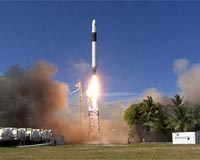
Hawthorne CA (SPX) Aug 08, 2008 On August 2nd, Falcon 1 executed a picture perfect first stage flight, ultimately reaching an altitude of 217 km, but encountered a problem just after stage separation that prevented the second stage from reaching orbit. At this point, we are certain as to the origin of the problem. Four methods of analysis - vehicle inertial measurement, chamber pressure, onboard video and a simple physics free body calculation - all give the same answer. The problem arose due to the longer thrust decay transient of our new Merlin 1C regeneratively cooled engine, as compared to the prior flight that used our old Merlin 1A ablatively cooled engine. Unlike the ablative engine, the regen engine had unburned fuel in the cooling channels and manifold that combined with a small amount of residual oxygen to produce a small thrust that was just enough to overcome the stage separation pusher impulse. We were aware of and had allowed for a thrust transient, but did not expect it to last that long. As it turned out, a very small increase in the time between commanding main engine shutdown and stage separation would have been enough to save the mission. The question then is why didn't we catch this issue? Unfortunately, the engine chamber pressure is so low for this transient thrust -- only about 10 psi -- that it barely registered on our ground test stand in Texas where ambient pressure is 14.5 psi. However, in vacuum that 10 psi chamber pressure produced enough thrust to cause the first stage to recontact the second stage. It looks like we may have flight four on the launch pad as soon as next month. The long gap between flight two and three was mainly due to the Merlin 1C regen engine development, but there are no technology upgrades between flight three and four.
Good Things About This Flight The stage separation system worked properly, in that all bolts fired and the pneumatic pushers delivered the correct impulse + Second stage ignited and achieved nominal chamber pressure + Fairing separated correctly + We discovered this transient problem on Falcon 1 rather than Falcon 9 + Rocket stages were integrated, rolled out and launched in seven days + Neither the near miss potential failures of flight two nor any new ones were present The only untested portion of flight is whether or not we have solved the main problem of flight two, where the control system coupled with the slosh modes of the liquid oxygen tank. Given the addition of slosh baffles and significant improvements to the control logic, I feel confident that this will not be an issue for the upcoming flight four. Community Email This Article Comment On This Article Share This Article With Planet Earth
Related Links Space Exploration Technologies Rocket Science News at Space-Travel.Com
 Rocket Racing League Conducts Rocket Racer Flights
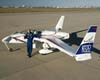 New York NY (SPX) Aug 07, 2008
The Rocket Racing League has celebrated the historic inaugural flights of the Rocket Racer, which captivated the hundreds of thousands of people on-hand at EAA AirVenture in Oshkosh, WI. |
|
|

| The content herein, unless otherwise known to be public domain, are Copyright 1995-2007 - SpaceDaily.AFP and UPI Wire Stories are copyright Agence France-Presse and United Press International. ESA Portal Reports are copyright European Space Agency. All NASA sourced material is public domain. Additional copyrights may apply in whole or part to other bona fide parties. Advertising does not imply endorsement,agreement or approval of any opinions, statements or information provided by SpaceDaily on any Web page published or hosted by SpaceDaily. Privacy Statement |
 del.icio.us
 Digg
Digg Reddit
 YahooMyWeb
 Google
 Facebook