|
 |
 |
 |
 |
 |
 |
 |
 |

 |
F22A Took Long Road To Initial Operational Capability
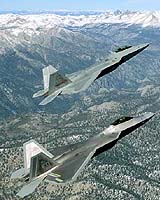
Edwards AFB CA (SPX) Jan 05, 2006 With the F-22A Raptor's initial operational capability declaration Dec. 15 came the capstone of a process that began 76 months earlier, in August 1997, when a C-5 Galaxy landed here and taxied down the expansive "Contractor's Row" with several crates and boxes in its cargo bay for what is now known as the F-22A Combined Test Force. Far from being just boxes of materiel or the world's largest model kit, this cargo, once assembled by the men and women of the F-22 test force, became the first of what is now officially the air superiority fighter providing air dominance for the Joint Force, the F-22A aircraft called "Raptor 1." The F-22A did not arrive at its current position by accident or the passage of days. Its present state is a compilation of thousands of test points successfully flown and analyzed in maintenance, and of hundreds of Air Force personnel -- active and civilian-- and of contractors from Lockheed, Boeing, Pratt and Whitney, Computer Sciences Corporation, Tybrin and JT3 who combined as one family to do the daily tasks of taking a raw airframe and turning it into something the world has never seen before. It was a human undertaking, one that seldom stopped, week in and week out, with few true weekends off, through the sacrifice of dozens of holidays. Through labor night and day, the CTF always sought to complete the building blocks of developmental flight test, one point at a time over a period of some 2,280 days. In its final year before IOC, the F-22A continued to rack up milestones. As the envelope expanded so did the aircraft capability, as witnessed by the addition of external fuel tanks and the need to be able to jettison them safely -- a test program that took weeks to complete. Not only was there the challenge of how the tanks could separate, but there was also the need to determine the design characteristics of external tanks to maintain low-observable, or stealth, capability for the aircraft. There was final work done to examine and validate the primary mission of the Raptor: air-to-air combat. In this area Raptor pilots flew dozens of hours over the Pacific Ocean and White Sands Missile Range, N.M., firing the AIM-120 Advanced Medium Range Air-to-Air Missile at supersonic speed, and while undergoing dramatic rolling flight profiles not capable by any other aircraft in the world. Most recently, the F-22A became the first aircraft in history to successfully drop a joint direct attack munition from an internal weapons bay while flying supersonic. And while the more visible components of final F-22A development testing were coming to a close, detailed work on the thousands of code items that make up the software package also continued this year. The CTF completed all mission avionics testing. This allowed the Raptor's "go-to-war" status to meet IOC capability and allowed for the aircraft to operate with the most capable operational flight program. Also, the F-22A completed all of its clean-wing envelope expansion testing, the final step to allow Lockheed Martin to complete its analysis of the plane's operational flight manual to meet IOC criteria. Arriving as it did, in the 50th year of the founding of the U.S. Air Force, and the 50th year of the breaking of the sound barrier by then Capt. Chuck Yeager, the F-22A stands now at the pinnacle of all the world's air forces, at the beginning of a new era. Community Email This Article Comment On This Article Related Links SpaceDaily Search SpaceDaily Subscribe To SpaceDaily Express Aerospace News at SpaceMart.com
 Northrop Grumman To Provide New Air Data Inertial Reference Units To Lufthansa
 Woodland Hills CA (SPX) Jan 12, 2006
Lufthansa will be one of the first commercial air carriers worldwide to benefit from the latest air data inertial reference units from Northrop Grumman. Inertial reference units provide aircrews with essential aircraft operational data such as aircraft position, velocities, attitude, altitude, air speed and many other parameters. |
|
|

| The content herein, unless otherwise known to be public domain, are Copyright 1995-2006 - SpaceDaily.AFP and UPI Wire Stories are copyright Agence France-Presse and United Press International. ESA PortalReports are copyright European Space Agency. All NASA sourced material is public domain. Additionalcopyrights may apply in whole or part to other bona fide parties. Advertising does not imply endorsement,agreement or approval of any opinions, statements or information provided by SpaceDaily on any Web page published or hosted by SpaceDaily. Privacy Statement |