|
 |
 |
 |
 |
 |
 |
 |
 |

 |
Extrasolar Planets: A Matter of Metallicity
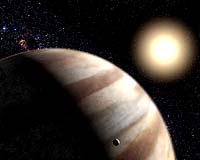
Moffett Field (SPX) Oct 12, 2004 Astronomers have discovered more than 130 planets orbiting nearby stars in our galaxy. Although the solar systems they have found are very different from ours, by studying the planets that have been found - their masses, their orbits and their stars - they are uncovering intriguing hints that our galaxy may be brimming with solar systems like our own. According to Greg Laughlin, an assistant professor of astronomy and astrophysics at UC Santa Cruz, planet hunters can expect, over time, to find hundreds of nearby stars with Neptune-like planets circling them at about 5 AU. (One AU, or astronomical unit, is the distance between the sun and Earth. Jupiter orbits our sun at about 5 AU.) A solar system with a large planet at 5 AU, astronomers believe, is one in which a habitable terrestrial-sized planet could also safely exist. Laughlin's prediction comes from studying a characteristic of stars that, until a few years ago, few paid much attention to: metallicity. New stars form when vast clouds of interstellar dust and gas collapse. This dust and gas is mostly primordial hydrogen and helium, but it also contains a smattering of heavier elements, which astronomers call "metals" (even though non-astronomers don't normally think of all of these elements as metals). The metallicity of a star tells you what portion of its material is made of metals. And, says Laughlin, "the one true indicator of whether a star is likely to have a detectable giant planet is its metallicity." These hot Jupiters and eccentric Jupiters, as they are known, are the easiest types of planets to detect; almost all the planets discovered to date are of these two types. And "the vast majority of extrasolar planets that are known so far are around metal-rich stars." Here's why. When a metal-rich interstellar cloud collapses, it forms a metal-rich star. According to the core-accretion theory, the dominant theory of planetary formation, this abundance of heavy material also enables large rocky planetary cores to form relatively quickly, within a few million years. Once these cores reach 10 Earth masses or more, they begin attracting hydrogen and helium gas from the collapsing cloud; they become gas giants. How big these giants get depends on how much gas they attract. But the hydrogen and helium don't stick around forever. So timing is critical: only large rocky cores that form before the gas disappears become gas giants. Cores that grow too slowly - the lower the metallicity of the collapsing cloud, the more slowly the cores grow - can't grab any gas. "If the disk lifetime is 4 million years and it takes you 5 million years to build a core, then you're out of luck," says Laughlin. "But if you can get that core buildup time down to 2.5 million years, say, then there's still plenty of gas available." Both of these types of planets can be seen in our solar system. "The sun is a metal-rich star, but not dramatically so," Laughlin says. When our solar system was forming, there was enough heavy material around for Jupiter and Saturn to form their cores quickly. They got gas. Neptune and Uranus, however, didn't make it to the starting gate. There is a strong correlation between high solar metallicity and hot Jupiters. The picture is fuzzier, though, for eccentric Jupiters, planets with elongated elliptical orbits that have been found out to an average distance of about 3 AU from their stars. And it is fuzzier still for planets with orbits like Jupiter's. Planets out at 5 AU take more than a decade to complete their trips around their stars; astronomers have only begun to confirm their presence. But Laughlin thinks he knows what to expect once all the data are in: lots of Neptune-mass planets, with some as massive as Saturn, in Jupiter-like orbits. Why Neptunes? Metallicity. The majority of the stars that U.S.-based planet hunters are studying have a bit more than half the metallicity of the sun. That's enough to form a large rocky planet like Neptune. There's no time limit on Neptunes. But it's not enough to form a core quickly; it's not enough to become a gas giant. So what are the prospects of finding solar systems that contain Earth-like planets? Pretty good, according to Laughlin. The solar systems that have been found so far, the ones that contain hot Jupiters or eccentric Jupiters, probably don't contain habitable Earth-like planets. The motions of these closer-in giants prevent terrestrial planets from forming stable orbits in the habitable zone. But a solar system with a large planet in a circular orbit at 5 AU - even a Neptune-sized planet - is a solar system in which a habitable Earth-like planet could exist quite comfortably. Indeed, Laughlin believes that, when all the data are in, we'll have discovered hundreds of nearby stars with solar systems much like our own, although the majority of them will have a Neptune or a Saturn at 5 AU rather than a Jupiter. True, planet hunters haven't found any such planets yet. But that doesn't mean they're not there. Astronomers just haven't been looking long enough to confirm their presence. With current planet-hunting techniques, Laughlin says, "it's not like you discover a planet - boom!" - in a single observation. "The planets emerge gradually," as a result of many, many observations over time. So just how long will it take to find such worlds? Well, that's the unfortunate part of the story. Although astronomers have already begun to detect large planets in Jupiter-like orbits, it will take another 10 to 20 years to complete the census of planets orbiting at 5 AU around nearby stars. "The amount of patience that you have to exercise to get a true Jupiter analog is really enormously more than the amount of patience that you need to find and detect a hot Jupiter or an eccentric giant," Laughlin says. But considering that 10 years ago no-one knew for sure whether there was even a single planet around a star other than our sun, perhaps another 10 or 20 years isn't such a long time to wait. Community Email This Article Comment On This Article Related Links Kepler Mission Darwin Mission Space Interferometry Mission SpaceDaily Search SpaceDaily Subscribe To SpaceDaily Express Lands Beyond Beyond - extra solar planets - news and science Life Beyond Earth
 Study Highlights Role Of Hit-And-Run Collisions In Planet Formation
 Santa Cruz CA (SPX) Jan 12, 2006
Hit-and-run collisions between embryonic planets during a critical period in the early history of the Solar System may account for some previously unexplained properties of planets, asteroids, and meteorites, according to researchers at the University of California, Santa Cruz, who describe their findings in a paper to appear in the January 12 issue of the journal Nature. |
|
|

| The content herein, unless otherwise known to be public domain, are Copyright 1995-2006 - SpaceDaily.AFP and UPI Wire Stories are copyright Agence France-Presse and United Press International. ESA PortalReports are copyright European Space Agency. All NASA sourced material is public domain. Additionalcopyrights may apply in whole or part to other bona fide parties. Advertising does not imply endorsement,agreement or approval of any opinions, statements or information provided by SpaceDaily on any Web page published or hosted by SpaceDaily. Privacy Statement |