
 |
 |
 |
 |
 |
 |
 |
 |
 |

 |
Extinction By Asteroid A Rarity
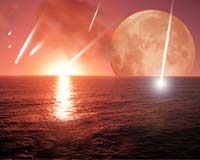
LOs Angeles CA (SPX) Oct 09, 2008 In geology as in cancer research, the silver bullet theory always gets the headlines and nearly always turns out to be wrong. For geologists who study mass extinctions, the silver bullet is a giant asteroid plunging to earth. But an asteroid is the prime suspect only in the most recent of five mass extinctions, said USC earth scientist David Bottjer. The cataclysm 65 million years ago wiped out the dinosaurs. "The other four have not been resolvable to a rock falling out of the sky," Bottjer said. For example, Bottjer and many others have published studies suggesting that the end-Permian extinction 250 million years ago happened in essence because "the earth got sick." The latest research from Bottjer's group suggests a similar slow dying during the extinction 200 million years ago at the boundary of the Triassic and Jurassic eras. At the 2008 Joint Annual Meeting of the Geological Society of America, USC doctoral student Sarah Greene drew similarities between ocean conditions at the Triassic-Jurassic boundary and after the end-Permian extinction. At both those times, bouquet-like structures of aragonite crystals formed on the ocean floor. Such structures are extremely rare in Earth's history, Greene said. "The fact that these deposits have only been found at these two specific times that are associated with mass extinction suggests at the very least that maybe there's some shared ocean geochemistry ... that could be related to the cause of the extinctions," Greene said. "The Triassic-Jurassic extinction cause is totally up for grabs at the moment," she added. Also at the meeting, USC doctoral student Rowan Martindale presented results from her studies of coral reefs during the Triassic-Jurassic extinction. "The coral reefs look actually very similar to modern coral reefs," she said. "At the end-Triassic mass extinction, you lose all your reef systems. And nobody's figured out why that is." Martindale identified two distinct types of ancient reefs: one dominated by coral and another consisting mainly of mud and debris, possibly held together by bacteria. A theory for the end-Triassic extinction needs to explain how both types of reefs could have been killed off, Martindale said. Any knowledge about end-Triassic reef death could be useful in understanding the current reef crisis, widely attributed to climate change. "We're looking at it as a model to give us any insight that we might have for today's decline for coral reefs," Bottjer said. Community Email This Article Comment On This Article Share This Article With Planet Earth
Related Links University of Southern California Darwin Today At TerraDaily.com
 Climate change poised to devastate penguins: WWF
 Barcelona (AFP) Oct 8, 2008
Half to three-quarters of major Antarctic penguin colonies could be damaged or wiped out if global temperatures are allowed to climb by more than two degrees Celsius (3.6 degrees Fahrenheit), according to a report released Wednesday. |
|
|

| The content herein, unless otherwise known to be public domain, are Copyright 1995-2007 - SpaceDaily.AFP and UPI Wire Stories are copyright Agence France-Presse and United Press International. ESA Portal Reports are copyright European Space Agency. All NASA sourced material is public domain. Additional copyrights may apply in whole or part to other bona fide parties. Advertising does not imply endorsement,agreement or approval of any opinions, statements or information provided by SpaceDaily on any Web page published or hosted by SpaceDaily. Privacy Statement |
 del.icio.us
 Digg
Digg Reddit
 YahooMyWeb
 Google
 Facebook