|
 |
 |
 |
 |
 |
 |
 |
 |

 |
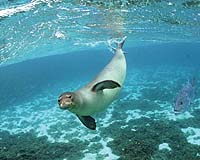
Extinct seal tells of once-teeming Caribbean reefs
Paris (AFP) March 19, 2008 Several hundred years ago, the coral reefs of the Caribbean had up to six times more fish than they have today, according to a study published Wednesday. The estimate is made by US scientists poring over the fate of the Caribbean monk seal, a fish-loving mammal driven to extinction in 1952. Historical records from the 17th and 18th century show there were huge numbers of monk seals, distributed among 13 colonies across the Caribbean. They were so plentiful that some ships' maps of the West Indies even noted particularly dense locations of seals. Alas for Monachus tropicalis, colonisation of the West Indies unleashed unbridled hunting, the bounty being seal oil that was used to grease machinery in sugar plantations. Towards the end of the 19th century, the seals were reduced to a final redoubt of a few atolls -- and their worst enemy became natural history museums and private collectors keen for monk seal skeletons. In one disastrous episode, a 1911 expedition to Mexico by natural-history enthusiasts killed 200 seals, leaving just a handful alive, and driving the depleted population further towards extinction. In a study published on Wednesday in the British journal Proceedings of the Royal Society B, oceanographers Loren McClenachan and Andrew Cooper perform a heroic act of biostatistics in recreating the life and sad demise of the seal. They calculate that, before the massacre, between 233,000 and 338,000 monk seals lived in the Caribbean. Such a huge population could only survive, of course, provided there was a huge supply of food. At a rough estimate, each adult seal would eat 245 kilos (539 pounds) of fish per year, and a juvenile seal 50 kilos, say McClenachan and Cooper. "The biomass of free fish required to sustained the estimated population of historical monk seals is four to six times greater than the average Caribbean reef, which exceeds that found on the most pristine Caribbean coral reef today and is in the same range of the most pristine reefs" in the remote Pacific, their paper says. The study gives a crucial pointer about the pace of degradation of Caribbean coral reefs, where the biggest problem has been overfishing. "Realistic construction of these past ecosystems is critical to understanding the profound and long-lasting effect of human hunting on the functioning of coral reef systems," they write. Extinction of the monk seal also had a huge knock-on effect across the Caribbean's food web. Removal of a major predator allowed some species of fish to expand at the expense of others, eventually transforming the picture of biodiversity. Community Email This Article Comment On This Article Related Links Water News - Science, Technology and Politics
 Scientists Solve 50-Year-Old Mystey Of Oceans' Seismic Buzz
 Pasadena CA (SPX) Mar 10, 2008
The latest buzz in Earth science literally comes from out of the blue-the deep blue seas. For the first time, scientists have pinpointed a specific area in the North Atlantic where microseisms, small Earth tremors created when ocean waves traveling in opposite directions merge together, are emitted from the depths of the ocean. |
|
|

| The content herein, unless otherwise known to be public domain, are Copyright 1995-2007 - SpaceDaily.AFP and UPI Wire Stories are copyright Agence France-Presse and United Press International. ESA Portal Reports are copyright European Space Agency. All NASA sourced material is public domain. Additional copyrights may apply in whole or part to other bona fide parties. Advertising does not imply endorsement,agreement or approval of any opinions, statements or information provided by SpaceDaily on any Web page published or hosted by SpaceDaily. Privacy Statement |