
 |
 |
 |
 |
 |
 |
 |
 |
 |

 |
Extinct Sabertooth Cats Were Social
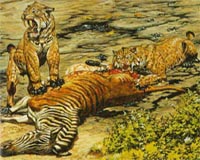
Los Angeles CA (SPX) Nov 06, 2008 The sabertooth cat (Smilodon fatalis), one of the most iconic extinct mammal species, was likely to be a social animal, living and hunting like lions today, according to new scientific research. The species is famous for its extremely long canine teeth, which reached up to seven inches in length and extended below the lower jaw. Instead of relying on the bones and teeth of the sabertooths to make their findings, scientists from UCLA and the Zoological Society of London concluded that the sabertooth cat was social by using a novel technique: They compared numbers of present-day carnivores competing for kills in Africa with those of mainly extinct species found in a North American fossil deposit. The research is published in the current issue of the Royal Society's journal Biology Letters (Oct. 28). Co-authors also included scientists from South Africa's Tshwane University of Technology and University of Pretoria. Smilodon existed in North and South America between 1.8 million and 10,000 years ago and is one of the most common species preserved at the Rancho La Brea tar pits of Los Angeles, a fossil deposit in which dying herbivores trapped in sticky asphalt attracted numerous dire wolves and sabertooth cats, some of which also died there. Because most living cats are solitary, controversy has persisted over the social life of Smilodon. The study reported in Biology Letters took a new approach to the question by comparing data from the La Brea fossil record and data obtained from "playbacks" used in Africa, in which the recorded calls of distressed prey and the sounds of lions and hyenas are used to attract carnivores. This technique has been used by scientists to estimate carnivore densities in eastern and southern Africa. Results showed that large social species made up a far larger proportion of the animals attracted than one would expect, considering their population size compared to other carnivores. Large social carnivores were, in fact, found to attend approximately 60 times more often than expected on the basis of relative abundance. When these results were compared with the records at the tar pits of California, the scientists found that the proportion of Smilodon records matched the proportion of the large social carnivores in the playbacks. "It absolutely makes sense that social species will predominate at carcasses, both now and in the past," said Blaire Van Valkenburgh, UCLA professor of ecology and evolutionary biology and senior author on the paper. "Why approach a situation where you are likely to encounter dangerous competitors without having a few friends along?" The same social advantage, she said, would apply to all scavengers, including early humans, who began consuming more meat about 2 million year ago, some of which they probably scavenged. Although commonly called the "sabertoothed tiger," the species is actually not closely related to the tiger, which is part of a different subfamily. However, the sabertooth cat was large and muscular, similar in size to a modern-day tiger. "The extinct sabertooth cat, Smilodon fatalis, has been something of an enigma, with almost nothing known of its behavior," said Chris Carbone, a senior research fellow at the Zoological Society of London and lead author of the paper. "This research allowed us to use the behavior of its present-day relatives to conclude that this extinct cat was more likely to roam in formidable gangs than as a secretive, solitary animal." Community Email This Article Comment On This Article Share This Article With Planet Earth
Related Links University of California - Los Angeles Darwin Today At TerraDaily.com
 India leads world in snake-bite deaths
 Colombo, Sri Lanka (UPI) Nov 4, 2008
 About 20,000 people die of snakebites worldwide each year, more than half of them in India, a study reveals. |
|
|

| The content herein, unless otherwise known to be public domain, are Copyright 1995-2007 - SpaceDaily.AFP and UPI Wire Stories are copyright Agence France-Presse and United Press International. ESA Portal Reports are copyright European Space Agency. All NASA sourced material is public domain. Additional copyrights may apply in whole or part to other bona fide parties. Advertising does not imply endorsement,agreement or approval of any opinions, statements or information provided by SpaceDaily on any Web page published or hosted by SpaceDaily. Privacy Statement |
 del.icio.us
 Digg
Digg Reddit
 YahooMyWeb
 Google
 Facebook