|
 |
 |
 |
 |
 |
 |
 |
 |

 |
Extensive Destruction Powers Solar Explosions
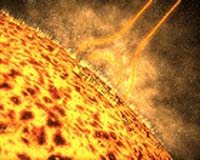
Greenbelt - Dec 11, 2003 Large-scale destruction of magnetic fields in the sun's atmosphere likely powers enormous solar explosions, according to a new observation from NASA's Ramaty High Energy Solar Spectroscopic Imager (RHESSI) spacecraft. The explosions, called solar flares, are capable of releasing as much energy as a billion one-megaton nuclear bombs. The destruction of magnetic fields, called magnetic reconnection, was a leading theory to explain how solar flares could suddenly release so much energy, but there were other possibilities as well. The new picture from RHESSI confirms large-scale magnetic reconnection as the most likely scenario. "Many observations gave hints that magnetic reconnection over large areas was responsible for solar flares, but the new pictures from RHESSI are the first that are really convincing," said Linhui Sui of the Catholic University of America, Washington. "The hunt for the energy source of flares has been like a story where villagers suspect a dragon is on the loose because something roars overhead in the middle of the night, but only something resembling the tail of a dragon is ever seen. With RHESSI, we've now seen both ends of the dragon." Linhui is lead author of a paper on this research published October 20 in Astrophysical Journal Letters. Magnetic reconnection can happen in the solar atmosphere because it is hot enough to separate electrons from atoms, producing a gas of electrically charged particles called plasma. Because plasma is electrically charged, magnetic fields and plasma tend to flow together. When magnetic fields and plasma are ejected from the sun, the ends of the magnetic fields remain attached to the surface. As a result, the magnetic fields are stretched and forced together until they break under the stress, like a rubber band pulled too far, and then reconnect -- snap -- to a new shape with less energy. The thin region where they reconnect is called the reconnection layer, and it is where oppositely directed magnetic fields come close enough to merge. Magnetic reconnection could power a solar flare by heating the sun's atmosphere to tens of millions of degrees, and accelerating electrically charged particles that comprise the plasma (electrons and ions) to almost the speed of light. At such high temperatures, solar plasma will shine in X-rays, and RHESSI observed high-energy X-rays, emitted by plasma, heated to tens of millions of degrees in a flare on April 15, 2002. The hot, X-ray emitting plasma initially appeared in the RHESSI images as a blob atop an arch of relatively cooler plasma protruding from the sun's surface. The blob-and-arch structure is consistent with reconnection, because the X-ray blob could be heated by reconnection, and the part of the magnetic field that breaks and snaps back to the solar surface will assume an arch shape. These structures have been seen before and hinted at reconnection, but the observations were not conclusive. However, as RHESSI made images of the 20-minute long flare, over the course of about four minutes during the most intense part of the flare, the X-ray emitting blob exhibited two characteristics consistent with large-scale magnetic reconnection. First, the blob split in two, with the top part ultimately rising away from the solar surface at a speed of about 700,000 miles per hour, or around 1.1 million km/hr. This is expected if extensive reconnection is occurring, because as the magnetic fields stretch, the reconnection layer also stretches, like taffy being pulled. Plasma heated by reconnection squirts out of the top and bottom of the reconnection layer, forming the two X-ray blobs in the RHESSI pictures, when the top and bottom are sufficiently far apart to be resolved as distinct areas. Second, in both blobs, the area closest to the apparent reconnection layer was hottest, and the area farthest away was coolest, according to temperature measurements by RHESSI. This is also expected if reconnection is occurring, because, as the magnetic fields break and reconnect, other magnetic fields nearby move in to the reconnection region and reconnect as well, since the overall, large-scale field continues to stretch. Thus, plasma is continuously heated and blasted out from the reconnection layer. The plasma closest to the reconnection area is the most recently expelled and therefore the hottest. Plasma farther away was ejected earlier and had time to cool. "This temperature gradient in the hot plasma was the clincher for me," said Dr. Gordon Holman, a Co-Investigator on RHESSI and co-author of the paper, at NASA's Goddard Space Flight Center, Greenbelt, Md. "If some other process was powering the flare, the hot plasma would not appear like this." Community Email This Article Comment On This Article Related Links SpaceDaily Search SpaceDaily Subscribe To SpaceDaily Express Solar Science News at SpaceDaily
 Tens Of Thousands Flock To Holy Baths In India During Solar Eclipse
 New Delhi (AFP) Oct 03, 2005
Tens of thousands of Hindu pilgrims across India jostled to take holy baths in the sacred River Ganges after performing special prayers for ancestors during a rare solar eclipse on Monday, television networks reported. |
|
|

| The content herein, unless otherwise known to be public domain, are Copyright 1995-2006 - SpaceDaily.AFP and UPI Wire Stories are copyright Agence France-Presse and United Press International. ESA PortalReports are copyright European Space Agency. All NASA sourced material is public domain. Additionalcopyrights may apply in whole or part to other bona fide parties. Advertising does not imply endorsement,agreement or approval of any opinions, statements or information provided by SpaceDaily on any Web page published or hosted by SpaceDaily. Privacy Statement |