|
 |
 |
 |
 |
 |
 |
 |
 |

 |
Explosions In Space May Have Initiated Ancient Extinction On Earth
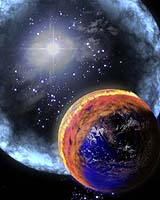
Lawrence KS (SPX) Apr 07, 2005 Scientists at NASA and the University of Kansas say that a mass extinction on Earth hundreds of millions of years ago could have been triggered by a star explosion called a gamma-ray burst. The scientists do not have direct evidence that such a burst activated the ancient extinction. The strength of their work is their atmospheric modeling - essentially a "what if" scenario. The scientists calculated that gamma-ray radiation from a relatively nearby star explosion, hitting the Earth for only ten seconds, could deplete up to half of the atmosphere's protective ozone layer. Recovery could take at least five years. With the ozone layer damaged, ultraviolet radiation from the Sun could kill much of the life on land and near the surface of oceans and lakes, and disrupt the food chain. Gamma-ray bursts in our Milky Way galaxy are indeed rare, but the scientists estimate that at least one nearby likely hit the Earth in the past billion years. Life on Earth is thought to have appeared at least 3.5 billion years ago. This research, supported by a NASA astrobiology grant, represents a thorough analysis of the "mass extinction" hypothesis first announced by members of this science team in September 2003. "A gamma-ray burst originating within 6,000 light years from Earth would have a devastating effect on life," said Dr. Adrian Melott of the Department of Physics and Astronomy at the University of Kansas, Lawrence. "We don't know exactly when one came, but we're rather sure it did come - and left its mark. What's most surprising is that just a 10-second burst can cause years of devastating ozone damage," Melott added. A scientific paper describing this finding appears in Astrophysical Journal Letters. The lead author is Brian Thomas, a Ph.D. candidate at University of Kansas. Gamma-ray bursts are the most powerful explosions known. Most originate in distant galaxies, and a large percentage likely arise from explosions of stars over 15 times more massive than our Sun. A burst creates two oppositely-directed beams of gamma rays that race off into space. Thomas says that a gamma-ray burst may have caused the Ordovician extinction 450 million years ago, killing 60 percent of all marine invertebrates. Life was largely confined to the sea, although there is evidence of primitive land plants during this period In the new work, the team used detailed computer models to calculate the effects of a nearby gamma-ray burst on the atmosphere and the consequences for life. Thomas, with Dr. Charles Jackman of NASA's Goddard Space Flight Center in Greenbelt, Md., calculated the effect of a nearby gamma-ray burst on the Earth's atmosphere. Gamma-rays, a high-energy form of light, can break molecular nitrogen (N2) into nitrogen atoms, which react with molecular oxygen (O2) to form nitric oxide (NO). NO will destroy ozone (O3) and produce nitrogen dioxide (NO2). NO2 will then react with atomic oxygen to reform NO. More NO means more ozone destruction. Computer models show that up to half the ozone layer is destroyed within weeks. Five years on, at least 10 percent is still destroyed. Next,researchers calculated the effect of ultraviolet radiation on life. Deep-sea creatures living several feet below water would be protected. Surface-dwelling plankton and other life near the surface, however, would not survive. Plankton is the foundation of the marine food chain. Dr. Bruce Lieberman, a paleontologist at the University of Kansas, originated the idea that a gamma-ray burst specifically could have caused the great Ordovician extinction, 200 million years before the dinosaurs. An ice age is thought to have caused this extinction. However, gamma-ray burst could have caused a fast die-out early on and also could have triggered the significant drop in surface temperature on Earth. "One unknown variable is the rate of local gamma-ray bursts," Thomas said. "The bursts we detect today originated far away billions of years ago, before the Earth formed. Among the billions of stars in our Galaxy, there's a good chance that a massive one relatively nearby exploded and sent gamma rays our way," he added. The Swift mission, launched in November 2004, will help determine recent burst rates. Community Email This Article Comment On This Article Related Links University of Kansas SpaceDaily Search SpaceDaily Subscribe To SpaceDaily Express Dirt, rocks and all the stuff we stand on firmly
 Magnetic Reconnection Region Larger Than 2.5 Million Km Found In The Solar Wind
 Paris (ESA) Jan 12, 2006
Using the ESA Cluster spacecraft and the NASA Wind and ACE satellites, a team of American and European scientists have discovered the largest jets of particles created between the Earth and the Sun by magnetic reconnection. This result makes the cover of this week's issue of Nature. |
|
|

| The content herein, unless otherwise known to be public domain, are Copyright 1995-2006 - SpaceDaily.AFP and UPI Wire Stories are copyright Agence France-Presse and United Press International. ESA PortalReports are copyright European Space Agency. All NASA sourced material is public domain. Additionalcopyrights may apply in whole or part to other bona fide parties. Advertising does not imply endorsement,agreement or approval of any opinions, statements or information provided by SpaceDaily on any Web page published or hosted by SpaceDaily. Privacy Statement |