|
 |
 |
 |
 |
 |
 |
 |
 |

 |
Exploring Lake Vostok Without Destroying It
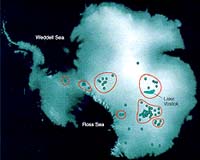
Washington - Mar 21, 2002 Lake Vostok, which lies buried under thousands of meters of ice high on the Antarctic Plateau, is thought to be home to unique habitats and microorganisms. Confirming the existence of life forms and unique biological niches without contaminating the pristine lake waters, however, is a difficult scientific and technical challenge with international ramifications. According to a paper to be published in the March 21 issue of Nature, the hydrodynamics of the lake may make it possible to search for evidence of life in the layers of ice that accumulate on the lake's eastern shore. Scientists say such a possibility would provide another avenue for exploring the lake's potential as a harbor of microscopic life, in addition to actually exploring the waters of the lake itself. The paper is authored by Robin E. Bell of Columbia University's Lamont-Doherty Earth Observatory and her colleagues. Their research, who were supported by the National Science Foundation (NSF), reveals that although the lake is perhaps millions of years old, its waters are relatively young. Bell's paper demonstrates that over a period of 13,300 years, all of the water was removed by the overlying ice sheet and replaced from other sources. The lake water captured by the moving ice sheet was carried as layers of ice over Lake Vostok's eastern shoreline, and then eastward away from the lake. Exploring those ice layers, they argue, is equivalent to exploring the lake itself. "Our study is a critical step in the exploration of Lake Vostok," Bell said. "These frozen lake water samples will record the passage of the ice sheet and the processes across the lake. The data show that the location of the current research station on the lake may not be optimal for biological studies." Bell added that that "Lake Vostok is absolutely devoid of interference. The youngest water in it is 400,000 years old. It doesn't know anything of human beings, fossil fuels, or plastics. It is a window into life forms and climates of primordial eras." Radar maps of the Antarctic interior made in 1996 revealed that a lake lay under the ice sheet. Lake Vostok is thought to be one of the world's largest, 48 kilometers (30 miles) wide by 225 kilometers (140 miles) long and 914 meters (3,000 feet) deep. Its waters have been sealed from air and light for perhaps as long as 35 million years under the tremendous pressure of the continental ice sheet. An ice core -- one of the world's longest -- was drilled by a joint U.S., Russian, and French team at Russia's Vostok Station on the lake's western shore. But coring was stopped roughly 100 meters (328 feet) above what is thought to be the surface of the water to prevent contamination of the lake. The ice layers reveal a 400,000-year environmental record with microorganisms present throughout most of the core. During the 2000-2001 Antarctic research season, NSF supported a detailed aerial mapping of the lake by specially equipped Twin Otter aircraft flown by the Support of Office for Aerogeophysical Research at the University of Texas at Austin. The radar sounding, laser altimetry, magnetics, and gravity surveys were a first, non-invasive step to explore Lake Vostok. Bell and her team analyzed the radar data and determined that the ice formation in the southern half of Lake Vostok holds buckling patterns frozen into the ice sheet as it flows over the lake. Following the trends of the buckled ice patterns, scientists were able to construct movement trajectories across the lake. They then calculated the time it took ice to move from the west side of the lake to the east�20,000 years over a distance of about 56 kilometers (35 miles). By examining the ice flux out of the lake, the team determined that every 13,300 years the ice sheet removes the equivalent of the entire volume of Lake Vostok. As the ice sheet removes lake water like a continuous conveyor belt, lake waters must be replenished, either by melting of the ice sheet or by subglacial meltwater. The source of this water remains a mystery. Community Email This Article Comment On This Article Related Links NSF: Subglacial Antarctic Lakes Committee The Habitat of Lake Vostok A Curiosity or a Focus for Interdisciplinary Study SOAR Aircraft International Scientific Committee on Antarctic Research SpaceDaily Search SpaceDaily Subscribe To SpaceDaily Express Dirt, rocks and all the stuff we stand on firmly
 Magnetic Reconnection Region Larger Than 2.5 Million Km Found In The Solar Wind
 Paris (ESA) Jan 12, 2006
Using the ESA Cluster spacecraft and the NASA Wind and ACE satellites, a team of American and European scientists have discovered the largest jets of particles created between the Earth and the Sun by magnetic reconnection. This result makes the cover of this week's issue of Nature. |
|
|

| The content herein, unless otherwise known to be public domain, are Copyright 1995-2006 - SpaceDaily.AFP and UPI Wire Stories are copyright Agence France-Presse and United Press International. ESA PortalReports are copyright European Space Agency. All NASA sourced material is public domain. Additionalcopyrights may apply in whole or part to other bona fide parties. Advertising does not imply endorsement,agreement or approval of any opinions, statements or information provided by SpaceDaily on any Web page published or hosted by SpaceDaily. Privacy Statement |