|
 |
 |
 |
 |
 |
 |
 |
 |

 |
Experts Develop Global Action Plan To Save Amphibians Facing Extinction
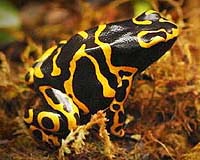
Washington DC (SPX) Sep 23, 2005 A summit of leading scientists have agreed to an action plan intended to save hundreds of frogs, salamanders and other amphibians facing extinction from familiar threats such as pollution and habitat destruction, as well as a little-known fungus wiping out their populations. The Amphibian Conservation Summit held Sept. 17-19 concluded with proposals for a series of actions, including emergency responses to save species under the greatest threat. More than 60 specialists convened by the Species Survival Commission of IUCN-The World Conservation Union drafted the seven-page Amphibian Conservation Action Plan declaration. It responds to findings in last year's Global Amphibian Assessment (GAA) that almost a third of the world's amphibians are in serious trouble, with dramatic declines since the 1980s signaling one of the worst extinction crises of our time. "We still have time to save these threatened species if appropriate conservation action is taken now," said Claude Gascon, chairman of the IUCN Global Amphibian Specialist Group and senior vice-president of Conservation International (CI). "This is kind of a Noah's Ark situation for amphibians, particularly because of the fungus. It is so deadly where it occurs, there really is no hope of saving a lot of these species if we leave them in the wild." According to the IUCN Red List of Threatened Species, 1,856 of the 5,743 known amphibian species � almost one in three � are threatened with extinction. By comparison, one in eight birds face a similar level of threat, and one in four mammals. The reasons are varied and all relate to the impact of humans on Earth � habitat loss, pollution, over-harvesting of species, and climate change. They often act in combination to exacerbate the declines. In addition, a new and serious threat is a chytrid fungal disease Batrachochytrium dendrobatidis that kills amphibians by attacking their sensitive skins. The little known pathogen was first identified six years ago and so far cannot be controlled in the wild. The action plan adopted at the summit addresses the key issues affecting the world's amphibians, and is divided into four key strategies:
"As a short-term response to prevent extinctions, the establishment of captive assurance colonies for the 200 or so most threatened species appears to be a promising option," said Simon Stuart, senior director of the IUCN/Biodiversity Assessment Unit and leader of the GAA research. "The good news is that the fungal disease can be eliminated from captive colonies." Captive breeding has been used successfully to conserve other species, such as the Hawaiian goose and Mallorcan midwife toad. The action plan proposes a major expansion of such programs in countries where species are the most threatened by the disease. The plan also calls for research into the control and elimination of the fungal disease in the wild, as well as greater habitat protection, to maintain or re-establish viable wild amphibian populations in the future. "Habitat destruction still remains the main threat to amphibians worldwide, and habitat conservation must continue as a priority" said Jim Collins, chair of the Declining Amphibian Population Task Force. "Amphibians often occur in relatively small areas and are more susceptible to extinction due to habitat loss or degradation than most other vertebrates." The sharp decline in amphibian populations could be ominous for all life on the planet. Because they live on land and in water, and their porous skins absorb oxygen and water, amphibians could be the first group to feel the effects of environmental changes from pollution, climate change and other causes. Community Email This Article Comment On This Article Related Links Global Amphibian Assessment SpaceDaily Search SpaceDaily Subscribe To SpaceDaily Express Darwin Today At TerraDaily.com
 Panda Paparrazi Swoons Over Cub Tai Shan At Washington Zoo
 Washington (AFP) Nov 29, 2005
There was 'panda-monium' at Washington's National Zoo on Tuesday as fluffy giant panda cub Tai Shan cavorted for the cameras, in his first encounter with the media pack. |
|
|

| The content herein, unless otherwise known to be public domain, are Copyright 1995-2006 - SpaceDaily.AFP and UPI Wire Stories are copyright Agence France-Presse and United Press International. ESA PortalReports are copyright European Space Agency. All NASA sourced material is public domain. Additionalcopyrights may apply in whole or part to other bona fide parties. Advertising does not imply endorsement,agreement or approval of any opinions, statements or information provided by SpaceDaily on any Web page published or hosted by SpaceDaily. Privacy Statement |