|
 |
 |
 |
 |
 |
 |
 |
 |

 |
Experts Debate China's Rise
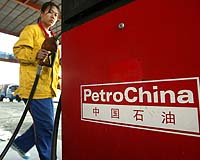
Washington (UPI) June 20, 2005 China's bid for a peaceful rise will be tested by its intention toward Taiwan and its quest for oil, experts say. Chinese officials maintain the country will move toward reform rather than violence in its efforts to establish a new international, political and economic order. It has no intention, they say, to threaten anyone by its rise. The Asian giant's ties with Taiwan, which Beijing regards as a renegade province, could affect those intentions, experts argue, as could its relations with nations such as Iran in its bid to feed its ever-expanding desire for energy. Chinese analysts, however, say the country's rise will be peaceful. "We are not seeking to become a big major power competing for hegemony around the world, but a big market a major civilization and responsible big power by constructive growth in the international community," said Zheng Bijian, Chairman of the China Reform Forum, a mainland think tank, at the Brookings Institution in Washington Thursday. The peaceful rise idea posits that China can emerge as one of the world's leading economies without threatening the international system. China, Zheng said, understood the historical and current context of the U.S. presence in the Asia-Pacific region and did not want to follow a "Monroe doctrine" to oust the United States. Instead, he said, Beijing would pursue a policy of "open multilateralism." The Monroe Doctrine is the policy adopted by U.S. President Monroe in 1823 to limit European political influence in the Americas. "We must concentrate all our energies on fulfilling this task," Zheng said. "We have neither the energy nor the intention to threaten others." He added that those who misread China's intentions were committing a serious mistake. "If people fail to see these important and basic concepts of Chinese leadership, which are in conformity with trend of our times, they may arrive at serious strategic misjudgment of China's action and will commit historical mistake," he said. Richard Bush III, a senior fellow at the centrist Brookings Institution, said Zheng's remarks sought to dispel the theory clashes are "preordained" when a rising power ascends in presence of an existing one. He said China's presence in the Western Hemisphere was "miniscule" and the United States had no reason to fear it. Not all policymakers agree. John J. Tkacik, Jr., a research fellow in China Policy, at the conservative Heritage Foundation in Washington, said Zheng's remarks excluded the furious debate of "China's peaceful rise" within the Communist Party, which saw it as an impediment toward its Taiwan policy. "The touchstone is the Taiwan issue," he said, adding the United States should use that as a yardstick to judge China's intentions toward its neighbors and toward the United States. Zheng justified the Chinese stance toward Taiwan, saying he did not see it as a deviation from the peaceful rise policy. "If Taiwan grows independent we reserve the right to attack," he said. "That is not outward expansion. It is necessary for safeguarding our territorial integrity." Bush of Brookings said the Chinese quest for oil would be the "perfect test" for its claims of peaceful rise. He said the long supply lines for oil were as much a security weakness as they were strength. Zheng said China was researching how to efficiently use its vast coal resources to meet its energy needs internally. To avoid increased consumption of energy, old-style industrialization characterized by high input, high consumption, high pollution will not work for China, he said. "China's growth would feature high technology inputs, economic efficiency, low consumption of resources, low pollution and approved strategy of human resources," Zheng said. As part of its bid to meet its growing energy needs, China has struck deals with government such as Iran, Sudan and Venezuela, all criticized by the United States for the record of freedom. Zheng acknowledged, however, that a peaceful rise was difficult, adding it was important for Beijing to confront fairness and economic returns, rural-urban disparity, wealth gap and relations between reform and stability though "Chinese characteristics." He said China wanted to maintain internal peace, leading 1.5 billion people toward a better life. "China's peaceful rise is the essence of a staunch force in forwarding rather than disrupting global peace," he said. Community Email This Article Comment On This Article Related Links SpaceDaily Search SpaceDaily Subscribe To SpaceDaily Express China News from SinoDaily.com
 China Wants To Expand Sino-US Military Relations
 Beijing (AFP) Jan 10, 2006
China is ready to expand its military relations with the United States, Chinese Defense Minister Cao Gangchuan said on Tuesday. |
|
|

| The content herein, unless otherwise known to be public domain, are Copyright 1995-2006 - SpaceDaily.AFP and UPI Wire Stories are copyright Agence France-Presse and United Press International. ESA PortalReports are copyright European Space Agency. All NASA sourced material is public domain. Additionalcopyrights may apply in whole or part to other bona fide parties. Advertising does not imply endorsement,agreement or approval of any opinions, statements or information provided by SpaceDaily on any Web page published or hosted by SpaceDaily. Privacy Statement |