|
 |
 |
 |
 |
 |
 |
 |
 |

 |
Experiments Validate 50-Year-Old Hypothesis
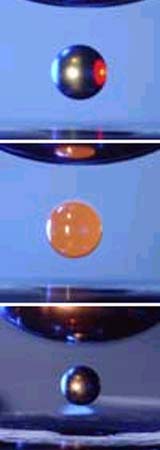
Huntsville - Jul 02, 2003 NASA-funded researchers recently obtained the first complete proof of a 50-year-old hypothesis explaining how liquid metals resist turning into solids. The research is featured on the cover of the July issue of Physics Today. It challenges theories about how crystals form by a process called nucleation, important in everything from materials to biological systems. "Nucleation is everywhere," said Dr. Kenneth Kelton, the physics professor who leads a research team from Washington University in St. Louis. "It's the major way physical systems change from one phase to another. The better we understand it, the better we can tailor the properties of materials to meet specific needs," he said. Using the Electrostatic Levitator at NASA's Marshall Space Flight Center in Huntsville, Ala., Kelton's team proved the hypothesis by focusing on the "nucleation barrier." German physicist Gabriel D. Fahrenheit, while working on his temperature scale, first observed the barrier in the 1700s. When he cooled water below freezing, it didn't immediately turn into ice but hung around as liquid in a supercooled state. That's because it took a while for all the atoms to do an atomic "shuffle" arranging in patterns to form ice crystals. In 1950, Dr. David Turnbull and Dr. Robert Cech, researchers at the General Electric Company in Schenectady, N.Y., showed liquid metals also resist turning into solids. In 1952, physicist Dr. Charles Frank, of the University of Bristol in England, explained this "undercooling" behavior as a fundamental mismatch in the way atoms arrange themselves in the liquid and solid phases. Atoms in a liquid metal are put together into the form of an icosahedron, a pattern with 20 triangular faces that can't be arranged to form a regular crystal. "The metal doesn't change to a solid instantly, because it costs energy for the atoms to move from the icosahedral formation in the liquid to a new pattern that results in a regular crystal structure in the solid metal," explained Kelton. "It's like being in a valley and having to climb over a mountain to get to the next valley. You expend energy to get over the barrier to a new place," he said. Frank didn't know about quasicrystals, first discovered in 1984, and researchers didn't have tools like NASA's Electrostatic Levitator. Using electrostatic energy to levitate the sample was crucial, because stray contamination from containers causes crystals to form inside liquid metals, which would have ruined Kelton's measurements on pure samples. To measure atom locations inside a drop of titanium-zirconium-nickel alloy, the levitator was moved to the Advanced Photon Source at Argonne National Laboratory in Chicago. There, an energetic beam of X-rays was used to map the average atom locations as the metal turned from liquid to solid. The experiment was repeated several times, and the data definitively verified Frank's hypothesis. As the temperature was decreased to solidify the molten sample, an icosahedral local structure developed in the liquid metal. It cost less energy to form the quasicrystal, because it had an icosahedral structure. This caused the quasicrystal to nucleate first, even though it was less stable than the crystal phase that should have formed. The icosahedral liquid structure was therefore directly linked to the nucleation barrier, as proposed by Frank. To prepare for an International Space Station experiment, the team is continuing levitator experiments. The new techniques being developed for these studies can be applied to solve advanced materials problems on Earth and for spacecraft applications. "As NASA scientists develop advanced materials for rocket engines and spacecraft, our facility will be a technological tool they can use to characterize materials," said Dr. Jan Rogers, a Marshall Center scientist who assisted Kelton's research team. Kelton's team at Washington University included Geun Wu Lee, a graduate student, and Anup Gangopadhyay, a research scientist; Jan Rogers, Tom Rathz and Mike Robinson, all of the Marshall Center; Robert Hyers, University of Massachusetts, Amherst; and Doug Robinson, Ames Laboratory, U.S. Department of Energy, Ames, Iowa. Kelton conducts his research under NASA's Materials Science Program managed by the Marshall Center. A peer-reviewed article that discusses this work appeared in the May 16 issue of Physical Review Letters. The research was featured in the May 30 issue of Science. Community Email This Article Comment On This Article Related Links More images and captions SpaceDaily Search SpaceDaily Subscribe To SpaceDaily Express Space Technology News - Applications and Research
 NGC Chosen To Proceed With Developing Solid-State Laser Technology For Military Applications
 Redondo Beach CA (SPX) Jan 09, 2006
Northrop Grumman Corporation has been selected to develop "military-grade," solid-state laser technology that is expected to pave the way for the U.S. military to incorporate high-energy laser systems across all services, including ships, manned and unmanned aircraft, and ground vehicles. |
|
|

| The content herein, unless otherwise known to be public domain, are Copyright 1995-2006 - SpaceDaily.AFP and UPI Wire Stories are copyright Agence France-Presse and United Press International. ESA PortalReports are copyright European Space Agency. All NASA sourced material is public domain. Additionalcopyrights may apply in whole or part to other bona fide parties. Advertising does not imply endorsement,agreement or approval of any opinions, statements or information provided by SpaceDaily on any Web page published or hosted by SpaceDaily. Privacy Statement |