|
 |
 |
 |
 |
 |
 |
 |
 |

 |
Expedition 14 Learn The Ropes As They Drill And Troubleshoot Equipment
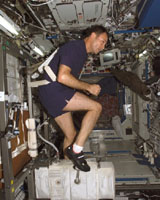
Houston TX (SPX) Oct 09, 2006 Expedition 14 completed its first full week solo on the International Space Station performing standard early mission checks, drills and some equipment troubleshooting. Expedition 14 Commander Michael Lopez-Alegria and Flight Engineer Mikhail Tyurin have been aboard the station for 19 days, while Flight Engineer Thomas Reiter of the European Space Agency is in his third month in orbit. Along with other work, the crew members prepared for a short trip away from the station next week, when they will fly the Soyuz spacecraft from one docking port to another. Early in the week, the crew conducted a check of procedures required to exit the station in an emergency, ensuring all necessary equipment is in place. Throughout the week, time was set aside for Lopez-Alegria and Tyurin to familiarize themselves with the station and operations. They started several new scientific activities and medical checks. Lopez-Alegria began his first session with the nutrition experiment. He collected blood and urine samples and began logging all of his consumed food and drink. The experiment, which tracks many vitamins and minerals essential for good health, is the most comprehensive in-flight study to date of human physiological changes during long-duration spaceflight. The information will help define nutritional requirements and food systems for future missions to the moon and Mars. Lopez-Alegria also supported the Passive Observatories for Experimental Microbial Systems in Micro-G (POEMS) experiment, by storing the next set of samples into the Minus-Eighty Laboratory Freezer for ISS (MELFI). MELFI is a cold storage unit that maintains experiment samples at temperatures of minus 80 degrees Celsius, minus 26 degrees Celsius or 4 degrees Celsius throughout a mission. POEMS will evaluate the effect of stress in the space environment on the generation of genetic variation in model microbial cells. On Friday, all crew members performed a normal periodic fitness evaluation, exercising on a stationary bicycle, measuring heart rates and blood pressure. One new scientific investigation began with Reiter as part of his evaluation. An oxygen uptake monitor provided by the European Space Agency was used to measure Reiter's oxygen consumption, a key parameter that can be used to measure fitness. The fitness evaluations are performed monthly. Lopez-Alegria and Tyurin also checked emergency medical equipment and supplies, a check done early in each crew's flight. Tyurin spent time mid-week continuing to troubleshoot the Russian Elektron oxygen-generation system. The system converts water into oxygen to replenish cabin air. It has not been functional since it overheated just before Expedition 14 arrived. The crew replaced components in an Elektron control panel this week, but problems persisted. Russian engineers are evaluating the system and further repairs may wait until the next supply ship arrives with additional parts. The next Progress cargo craft launches later this month. Plentiful oxygen supplies are available on the station. Oxygen is being replenished from tanks located on the Quest airlock. U.S. flight controllers are evaluating a vibration seen in one of the station's Control Moment Gyroscopes (CMGs) this week. The electrically powered CMGs maintain the station's orientation so thrusters and limited fuel are not used for that purpose. The vibrations were first observed Sept. 28 as a station maneuver was performed using thrusters. The gyroscope, CMG-3, was taken off line to allow additional testing. Since then, controllers have run various tests with CMG-3 to better characterize the intermittent vibrations. Engineers have determined it could be put back on line and into normal operation, if needed. Only three CMGs are necessary to properly maintain the station's orientation. The station crew members will board the Soyuz spacecraft docked at the rear of the Zvezda living quarters module on Tuesday to prepare for the short move. NASA TV will cover the activity live beginning at 2:45 p.m. EDT. With Soyuz Commander Tyurin at the controls, they will undock from the Zvezda port at 3:14 p.m. and re-dock to the Earth-facing Zarya module port at 3:39 p.m. EDT. NASA's payload operations team at the agency's Marshall Space Flight Center, Huntsville, Ala., coordinates U.S. science activities on the station. Community Email This Article Comment On This Article Related Links Space Station News at Space-Travel.Com Space Station News at Space-Travel.Com
 Japan Proposes Scientific Experiments In Russian Segment Of ISS
 Moscow (RIA Novosti) Oct 04, 2006
Japanese scientists are interested in carrying out a range of scientific experiments in the Russian segment of the International Space Station, the press secretary of the Federal Space Agency (Roskosmos) said Tuesday. |
|
|

| The content herein, unless otherwise known to be public domain, are Copyright 1995-2006 - SpaceDaily.AFP and UPI Wire Stories are copyright Agence France-Presse and United Press International. ESA PortalReports are copyright European Space Agency. All NASA sourced material is public domain. Additionalcopyrights may apply in whole or part to other bona fide parties. Advertising does not imply endorsement,agreement or approval of any opinions, statements or information provided by SpaceDaily on any Web page published or hosted by SpaceDaily. Privacy Statement |