
 |
 |
 |
 |
 |
 |
 |
 |
 |

 |
Exoplanet Hunt Update
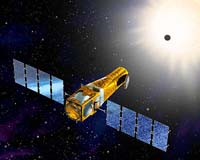
Boston MA (SPX) May 22, 2008 Two new exoplanets and an unknown celestial object are the latest findings of the COROT mission. These discoveries mean that the mission has now found a total of four new exoplanets. These results were presented this week at the IAU symposium 253 in Massachusetts, USA. COROT has now been operating for 510 days, and the mission started observations of its sixth star field at the beginning of May this year. During this observation phase, which will last 5 months, the spacecraft will simultaneously observe 12 000 stars. The two new planets are gas giants of the hot Jupiter type, which orbit very close to their parent star and tend to have extensive atmospheres because heat from the nearby star gives them energy to expand. In addition, an oddity dubbed 'COROT-exo-3b' has raised particular interest among astronomers. It appears to be something between a brown dwarf, a sub-stellar object without nuclear fusion at its core but with some stellar characteristics, and a planet. Its radius is too small for it to be a super-planet. If it is a star, it would be among the smallest ever detected. Follow-up observations from the ground have pinned it at 20 Jupiter massses. This makes it twice as dense as the metal Platinum. Scientists suspect that with the detection of COROT-exo-3b, they might just have discovered between stars and planets. COROT has also detected extremely faint signals that, if confirmed, could indicate the existence of another exoplanet, as small as 1.7 times Earth's radius. This is an encouraging sign in the delicate and difficult search for small, rocky exoplanets that COROT has been designed for. Community Email This Article Comment On This Article Share This Article With Planet Earth
Related Links COROT at ESA Lands Beyond Beyond - extra solar planets - news and science Life Beyond Earth
 Planets By The Dozen
 Huntsville AL (SPX) May 12, 2008
You know the planets of our solar system, each a unique world with its own distinctive appearance, size, and chemistry. Mars, with its bitter-cold, rusty red sands; Venus, a fiery world shrouded in thick clouds of sulfuric acid; sideways Uranus and its strange vertical rings. The variety is breathtaking. |
|
|

| The content herein, unless otherwise known to be public domain, are Copyright 1995-2007 - SpaceDaily.AFP and UPI Wire Stories are copyright Agence France-Presse and United Press International. ESA Portal Reports are copyright European Space Agency. All NASA sourced material is public domain. Additional copyrights may apply in whole or part to other bona fide parties. Advertising does not imply endorsement,agreement or approval of any opinions, statements or information provided by SpaceDaily on any Web page published or hosted by SpaceDaily. Privacy Statement |
 del.icio.us
 Digg
Digg Reddit
 YahooMyWeb
 Google
 Facebook