|
 |
 |
 |
 |
 |
 |
 |
 |

 |
Evidence Of Meteor Impact Found Off Australian Coast
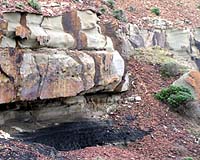
Santa Barbara (SPX) May 14, 2004 An impact crater believed to be associated with the "Great Dying," the largest extinction event in the history of life on Earth, appears to be buried off the coast of Australia. NASA and the National Science Foundation (NSF) funded the major research project headed by Luann Becker, a scientist at the University of California, Santa Barbara (UCSB). Science Express, the electronic publication of the journal Science, published a paper describing the crater today. Most scientists agree a meteor impact, called Chicxulub, in Mexico's Yucatan Peninsula, accompanied the extinction of the dinosaurs 65 million years ago. But until now, the time of the Great Dying 250 million years ago, when 90 percent of marine and 80 percent of land life perished, lacked evidence and a location for a similar impact event. Becker and her team found extensive evidence of a 125-mile- wide crater, called Bedout, off the northwestern coast of Australia. They found clues matched up with the Great Dying, the period known as the end-Permian. This was the time period when the Earth was configured as one primary land mass called Pangea and a super ocean called Panthalassa. During recent research in Antarctica, Becker and her team found meteoric fragments in a thin claystone "breccia" layer, pointing to an end-Permian event. The breccia contains the impact debris that resettled in a layer of sediment at end- Permian time. They also found "shocked quartz" in this area and in Australia. "Few Earthly circumstances have the power to disfigure quartz, even high temperatures and pressures deep inside the Earth's crust," Becker said. Quartz can be fractured by extreme volcanic activity, but only in one direction. Shocked quartz is fractured in several directions and is therefore believed to be a good tracer for the impact of a meteor. Becker discovered oil companies in the early 70's and 80's had drilled two cores into the Bedout structure in search of hydrocarbons. The cores sat untouched for decades. Becker and co-author Robert Poreda went to Australia to examine the cores held by the Geological Survey for Australia in Canberra. "The moment we saw the cores, we thought it looked like an impact breccia," Becker said. Becker's team found evidence of a melt layer formed by an impact in the cores. In the paper, Becker documented how the Chicxulub cores were very similar to the Bedout cores. When the Australian cores were drilled, scientists did not know exactly what to look for in terms of evidence of impact craters. Co-author Mark Harrison, from the Australian National University in Canberra, determined a date on material obtained from one of the cores, which indicated an age close to the end-Permian era. While in Australia on a field trip and workshop about Bedout, funded by the NSF, co-author Kevin Pope found large shocked quartz grains in end-Permian sediments, which he thinks formed as a result of the Bedout impact. Seismic and gravity data on Bedout are also consistent with an impact crater. The Bedout impact crater is also associated in time with extreme volcanism and the break-up of Pangea. "We think that mass extinctions may be defined by catastrophes like impact and volcanism occurring synchronously in time," Becker said. "This is what happened 65 million years ago at Chicxulub but was largely dismissed by scientists as merely a coincidence. With the discovery of Bedout, I don't think we can call such catastrophes occurring together a coincidence anymore," she added. Community Email This Article Comment On This Article Related Links Australian Potential Meteor Site SpaceDaily Search SpaceDaily Subscribe To SpaceDaily Express Asteroid and Comet Impact Danger To Earth - News and Science
 NASA'S Deep Impact Tells A Tale Of The Comet
 Pasadena CA (SPX) Jul 11, 2005
Data from Deep Impact's instruments indicate an immense cloud of fine powdery material was released when the probe slammed into the nucleus of comet Tempel 1 at 6.3 miles per second. |
|
|

| The content herein, unless otherwise known to be public domain, are Copyright 1995-2006 - SpaceDaily.AFP and UPI Wire Stories are copyright Agence France-Presse and United Press International. ESA PortalReports are copyright European Space Agency. All NASA sourced material is public domain. Additionalcopyrights may apply in whole or part to other bona fide parties. Advertising does not imply endorsement,agreement or approval of any opinions, statements or information provided by SpaceDaily on any Web page published or hosted by SpaceDaily. Privacy Statement |