|
 |
 |
 |
 |
 |
 |
 |
 |

 |
Evergreen Unveils Thin Wafer Breakthrough For String Ribbon Solar Tech
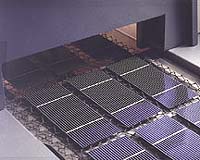
Marlboro MA (SPX) Dec 10, 2004 Evergreen Solar has announced a major advance in the development of its String Ribbon manufacturing process that has the potential to produce silicon wafers thinner than 150 microns. The Company has filed a patent application for its thin wafer technology. "Evergreen Solar's mission since its inception has been to produce high-quality solar products at a fraction of the cost of conventional methods," said Richard M. Feldt, President and Chief Executive Officer. "Today we are announcing an important step in realizing that goal. With the latest enhancement to our Gemini II double ribbon growth process, Evergreen Solar has demonstrated in its pilot operations that it can manufacture wafers using one third of the silicon required by conventional methods - significantly reducing the overall cost of producing solar panels. "The ability to produce the thinnest wafers in the solar industry affords our Company with a decided competitive advantage that no other company has demonstrated. This breakthrough demonstrates the robustness of our String Ribbon manufacturing process." "By changing the growing conditions in our Gemini II furnaces, we can produce wafers that are half the thickness of our current standard," said Dr. Brown F. Williams, Vice President, Research and Development. "This achievement directly cuts the use of silicon in half for us and by a factor of three when compared to conventional methods." "Our competitors produce wafers by sawing slices of silicon off of large ingots. The silicon lost in the width of the saw cut means that other wafer manufacturers are effectively throwing away half of their silicon starting material. "Our standard String Ribbon process already avoids that shrinkage. Moreover, because current cutting techniques have difficulty producing wafers as thin as 150 microns, we truly have a unique, defensible competitive advantage," Williams added. Feldt said, "There is some concern that the tightening silicon supplies may limit the growth of the photovoltaic industry for the next year or two. Our technology's potential to further reduce silicon requirements is really quite dramatic and holds great promise for our industry. We expect that production of our thin wafers will entail other savings in material costs and the thin wafers will perform at a higher level of efficiency." "The yield from the pilot quantities of our thin wafers processed into solar cells and assembled into complete panels has been encouraging. As a result, we will methodically scale our pilot operations and debug our wafer, cell and panel manufacturing processes for thin ribbons. Based on our preliminary work to date, we would expect to be able to achieve production status by the end of 2005. Additionally, we expect this breakthrough should position us even more favorably with potential partners as we proceed with planning for our next commercial expansion," Feldt concluded. Community Email This Article Comment On This Article Related Links Evergreen Solar SpaceDaily Search SpaceDaily Subscribe To SpaceDaily Express Space Technology News - Applications and Research
 Industry Team Achieve New Communications Technology With AESA Radars
 Baltimore MD (SPX) Jan 12, 2006
A team comprised of three leading US aerospace and defense contractors has demonstrated an innovative technological use of active electronically scanned array (AESA) radars for high-bandwidth communications. |
|
|

| The content herein, unless otherwise known to be public domain, are Copyright 1995-2006 - SpaceDaily.AFP and UPI Wire Stories are copyright Agence France-Presse and United Press International. ESA PortalReports are copyright European Space Agency. All NASA sourced material is public domain. Additionalcopyrights may apply in whole or part to other bona fide parties. Advertising does not imply endorsement,agreement or approval of any opinions, statements or information provided by SpaceDaily on any Web page published or hosted by SpaceDaily. Privacy Statement |