
 |
 |
 |
 |
 |
 |
 |
 |
 |

 |
Even Seaweeds Get Sunburned
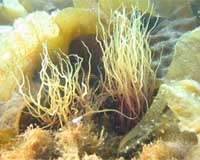
Bremerhaven, Germany (SPX) Aug 28, 2008 It is red, it burns and itches: a sunburn on our skin. However, too much sun is not only bad for humans. Many plants react sensitively to an increased dose of ultraviolet radiation, too. Yet they are dependent on sunlight. With the help of pigments absorbing solar energy and light, plants produce their vitally important building blocks by means of photosynthesis. However, this has its limits: too much sun means an over-abundance of energy and thus the destruction of the sensitive pigments. The result are black spots, pale leaves and rotten parts. Since algae cannot apply sun lotion like we do, they develop their own strategies to protect from the sun: "A species of red algae, for instance, produces under increased ultraviolet radiation less red light-harvesting proteins, thus decreasing the absorption of radiation. The typical red colour of the alga fades and the plant gets white tips.," explains Prof. Dr. Christian Wiencke, marine biologist at the Alfred Wegener Institute for Polar and Marine Research in the Helmholtz Association. "The algae additionally produce substances which react similar to melanin in human skins: mycosporin amino acids (MAA)." Melanin absorbs ultraviolet radiation and thus protects the human skin - at the same time, it gives a natural suntan. The ozone layer usually absorbs the major part of the hard and harmful solar ultraviolet radiation of short wavelength. However, because of stratospheric ozone depletion, these dangerous rays increasingly penetrate to the earth's surface and therefore also to the seawater. Extensive biological experiments are presently conducted on this complex of problems at the German French Research Base AWIPEV on Spitsbergen. "We examine the harmful effects of ultraviolet radiation on algae and their protective mechanisms," says Wiencke. The ultraviolet radiation particularly harms the algae's photosynthesis and their hereditary material. These organisms usually react with a decreased rate of growth or a reduction of reproductive success. The spores and germ cells of the algae which drift through the water as unicellular organisms are particularly sensitive. Even small ultraviolet doses are damaging and inhibit their germination. "Our investigations show that the distribution of certain species of brown algae is inhibited by the climate of ultraviolet radiation. The algae are displaced into deeper water layers if ultraviolet radiation increases." The research conditions on Spitsbergen are optimal for Wiencke and his colleagues: "We want to observe the development of marine coastal ecosystems in the face of global climate change. Not only an increased ultraviolet radiation plays a decisive role, but also the water temperature which has been increased by the greenhouse effect. This increase in temperature can particularly be felt on Spitsbergen, in the Atlantic sector of the Arctic." Community Email This Article Comment On This Article Share This Article With Planet Earth
Related Links Helmholtz Association of German Research Centres Darwin Today At TerraDaily.com
 Through A Glass Darkly
 Moffett Field CA (SPX) Aug 27, 2008
Stained glass windows decorate the world's most beautiful cathedrals, and the jewel-colored panels often depict religious stories. According to ongoing research, life may have its own tales to tell in ancient glass. |
|
|

| The content herein, unless otherwise known to be public domain, are Copyright 1995-2007 - SpaceDaily.AFP and UPI Wire Stories are copyright Agence France-Presse and United Press International. ESA Portal Reports are copyright European Space Agency. All NASA sourced material is public domain. Additional copyrights may apply in whole or part to other bona fide parties. Advertising does not imply endorsement,agreement or approval of any opinions, statements or information provided by SpaceDaily on any Web page published or hosted by SpaceDaily. Privacy Statement |
 del.icio.us
 Digg
Digg Reddit
 YahooMyWeb
 Google
 Facebook