|
 |
 |
 |
 |
 |
 |
 |
 |

 |
Europe's comet-chasing probe completes key flyby
Paris (AFP) Nov 14, 2007 A billion-euro (1.45-billion-dollar) European scout craft completed a crucial fly-by of Earth to pick up speed on its 10-year mission to rendezvous with a distant comet, the European Space Agency (ESA) said on Wednesday. "An important milestone has just been accomplished," the Paris-based agency said after the Rosetta probe raced over the Pacific Ocean southwest of Chile late Tuesday at 45,000 kilometers (28,125 miles) per hour and a height of 5,295 kilometres (3,309 miles). Rosetta, launched in 2014, has flown just over three billion kilometres (1.8 billion miles) of its scheduled trek of 7.1 billion kilometers (4.4 billion miles). It is due to meet up with Comet 67/P Churyumov-Gerasimenko in 2014, 675 million kilometres (422 million miles) from home. Flying in tandem with the comet, Rosetta will use remote sensors to get detailed imaging of the celestial wanderer and dispatch a refrigerator-sized robot lab to carry out a chemical analysis of its surface. To make the rendezvous, Rosetta has to pick up speed from "gravitational assists" -- using the gravitational pull of Earth and Mars as a catapult. It was the craft's third planetary swingby and its second of Earth. The third and final fly-by of our planet will be in November 2009, ESA said. Rosetta's latest fly-by triggered a small scare last week among skygazers who keep a watch on dangerous asteroids. The clearing-house of information about these hazards, the Minor Planet Center (MPC), issued an alert to professional observatories after automated scanners identified the incoming Rosetta as a potentially threatening "Near-Earth Object." The MPC designated the sighting as 2007 VN84 before withdrawing its advisory after it was told of the mistake. In a message reported by astronomy media, the MPC said the incident shed light on "the deplorable state of availability of positional information" about man-made satellites that are in distant tracks from Earth. The MPC is run by the Smithsonian Astrophysical Observatory in Massachusetts for the Paris-based International Astronomical Union (IAU). Astronomers believe that comets, as primitive rubble left over from the making of the Solar System, can help to explain how planets formed and even how life started on Earth. Community Email This Article Comment On This Article Related Links Space Tourism, Space Transport and Space Exploration News
 Boeing Completes Prototype Heat Shield For NASA Orion Spacecraft
 St. Louis MO (SPX) Nov 14, 2007
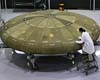
Boeing has completed a developmental heat shield for NASA's Orion Crew Exploration Vehicle (CEV) that is designed to protect future astronauts from extreme heat during re-entry into Earth's atmosphere following lunar and low-Earth orbit missions. NASA Ames Research Center last year awarded Boeing Advanced Systems a contract to deliver a Thermal Protection System (TPS) Manufacturing Demonstration Unit (MDU) for the Orion capsule as part of NASA's Constellation program to return humans to the moon and on to Mars. |
|
|

| The content herein, unless otherwise known to be public domain, are Copyright 1995-2007 - SpaceDaily.AFP and UPI Wire Stories are copyright Agence France-Presse and United Press International. ESA Portal Reports are copyright European Space Agency. All NASA sourced material is public domain. Additional copyrights may apply in whole or part to other bona fide parties. Advertising does not imply endorsement,agreement or approval of any opinions, statements or information provided by SpaceDaily on any Web page published or hosted by SpaceDaily. Privacy Statement |