|
 |
 |
 |
 |
 |
 |
 |
 |

 |
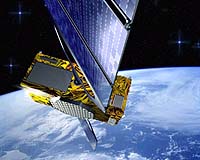
Europe's Galileo Project And Leadership In Space Enterprises
Hamburg - Mar 28, 2003 In the dispute between Italy and Germany on the leading role in the European satellite navigation system Galileo, Sigmar Wittig, director of the German space agency DLR (Deutsches Zentrum f�r Luft- und Raumfahrt), recently claimed leadership, because of Germany's financial contributions to the project. Does that sound reasonable to you? Leadership is a very sensitive issue in space missions. It's quite understandable that the US insisted, the commander of the first permanent ISS crew had to be American. But it's also understandable that Russian cosmonaut Anatoly Solowjew rejected to be a member of that crew. At that time Solowjew could claim to be probably the most experienced space traveler (to avoid the Cold War distinction between astronauts and cosmonauts) on Earth, with four missions summing up to 14 months in space and more EVA hours than anyone else. And shouldn't the best be the leaders? Right, experience doesn't necessarily make a good leader. But big bucks or Euros doesn't make it either. Paying for something gives you the right to control your money isn't wasted, but not automatically the right to lead. Studies in space flight analogue environments have shown that an effective leader in human space flight is one that seeks advice from crew members through frequent contact, uses impartiality in decision making, and expresses concern over crew members' well-being. And for all team members Canadian astronaut Roberta Bondar named "compassion, understanding and the ability to communicate" as the three most important requirements. That sounds like a good foundation for ground teams, too. There's another important component. Creating something new and big like a space infrastructure requires creative leadership. It needs leaders that have an idea of the dimensions of space - not only the physical, but the mental ones. Going to space is probably the biggest cultural revolution in human history, offering an unprecented multitude of perceptions, perspectives, opportunities. It's a variety that doesn't fit into account books. Of course, space exploration needs to be done on a sound financial basis. But money only can pave the way into space. It cannot show the direction. If Wittig doesn't have more to his side than money, he should think twice if he really wants to lead Galileo. Dr. Hans-Arthur Marsiske is a science journalist based in Germany who writers occassional articles for SpaceDaily.com among many other publications in Europe. Community Email This Article Comment On This Article Related Links Dr. Hans-Arthur Marsiske Website SpaceDaily Search SpaceDaily Subscribe To SpaceDaily Express GPS Applications, Technology and Suppliers
 Galileo GIOVEA Using Marotta Equipment For Its Propulsion Systems
 Cheltenham, England (SPX) Jan 09, 2006
Marotta UK is pleased to announce that it designed, developed and qualified equipment for the cold gas propulsion systems on board the Galileo GIOVE-A, part of Europe's Galileo navigation program, successfully launched by Surrey Satellite Technology (SSTL). |
|
|

| The content herein, unless otherwise known to be public domain, are Copyright 1995-2006 - SpaceDaily.AFP and UPI Wire Stories are copyright Agence France-Presse and United Press International. ESA PortalReports are copyright European Space Agency. All NASA sourced material is public domain. Additionalcopyrights may apply in whole or part to other bona fide parties. Advertising does not imply endorsement,agreement or approval of any opinions, statements or information provided by SpaceDaily on any Web page published or hosted by SpaceDaily. Privacy Statement |