|
 |
 |
 |
 |
 |
 |
 |
 |

 |
Europe's GEANT computer network extends its reach
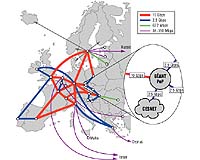
Brussels (AFP) Feb 29, 2008 The world's highest-speed computer network, Europe's GEANT, is linking up with others worldwide to create a global research network, the European Commission announced Friday. GEANT, the world's largest computer network dedicated to research and education, already links researchers from Reykjavik to Vladivostok. Now high-sepeed links will be established with similar research systems in Asia, Latin America and southern Africa, as well as the Balkans, the Black Sea and Mediterranean regions, with help from European funding, the EU's executive arm said. "With GEANT's massive data processing capacity, Europe can now bring together the best minds in the world to tackle the challenges that we all face," enthused EU Information and Media Commissioner Viviane Reding. GEANT was launched in 2000 and is jointly funded by Brussels and participating nations. The commission also announced a further 90 million euros (136 million dollars) in funding for the project up to 2012. The network already boasts a total of 50,000 kilometres of super-fast 'dark' fibre-optic connections linked to hybrid networking technology, allowing for 320 gigabits of information to stream through per second. It serves some 30 million users in over 3,500 universities and research centres and connects 34 national research networks. In a statement, the commission praised the GEANT project as providing "huge technological advances for big science," including EXPReS, an EU radio astronomy project which links the world's largest radio telescopes in China, Europe, South Africa and Chile to a supercomputer in the Netherlands which produces real-time imaging. Community Email This Article Comment On This Article Related Links Space Technology News - Applications and Research
 Game consoles can model black holes, drug molecules
 Paris (AFP) Feb 13, 2008
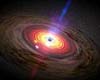
Researchers are cannibalising the Sony PlayStation 3 console and other gaming hardware, turning them into low-cost supercomputers to model pharmaceutical molecules and black holes, the weekly New Scientist says. |
|
|

| The content herein, unless otherwise known to be public domain, are Copyright 1995-2007 - SpaceDaily.AFP and UPI Wire Stories are copyright Agence France-Presse and United Press International. ESA Portal Reports are copyright European Space Agency. All NASA sourced material is public domain. Additional copyrights may apply in whole or part to other bona fide parties. Advertising does not imply endorsement,agreement or approval of any opinions, statements or information provided by SpaceDaily on any Web page published or hosted by SpaceDaily. Privacy Statement |