|
 |
 |
 |
 |
 |
 |
 |
 |

 |
Europeans Space Program Must Become More Independent
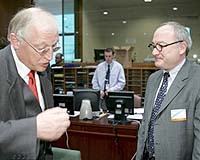
Berlin (AFP) Dec 05, 2005 Europe's space programme, facing intense competition, can become more independent only if it makes the best possible use of the continent's resources, ministers from 17 nations and Canada were told on Monday. "We must definitely contribute to further progress in securing Europe's position as a leading knowledge-based society," Dutch Economy Minister Laurens Jan Brinkhorst said at the start of a two-day meeting of the European Space Agency (ESA) in the German capital. "I believe this can be achieved only if Europe makes the best use of the available resources of ESA and of the member states." The ESA is mapping out strategies for funding new projects over the next five years. It has earmarked 8.8 billion euros (10.3 billion dollars) for the 2006-2010 period. Proposed schemes include exploratory missions to the Moon and Mars, Earth-observation satellites, telecommunications, scientific research in zero gravity and next-generation launch technology. By comparison, NASA has raised its budget for 2006 by 2.4 percent to 16.5 billion dollars as part of President George W. Bush's strategy for reviving manned US missions to the Moon and, later, to Mars. Russia, which sends more craft into space than anyone else, has a small budget in comparison of 220 million dollars for next year. China and India are the other emerging space powers, both of which have rising budgets. The ESA last month sent its first Venus probe to explore the planet's atmosphere and runaway global warming in the hope of better understanding Earth's greenhouse-gas problem. The satellite, Venus Express, is the sister to the highly successful Mars Express orbiting the Red Planet. Launchers, which are used to put satellites in space, are one of the key thrusts of the five-year plan and accounted for more than one quarter of all the contracts signed by ESA last year. ESA is seeking to oblige member states to use European launchers, rather than opt for the potentially cheaper options offered by Russia or India, one source close to the Agency said. An agreement on the launchers would send out a "strong political signal" about the European space programme to the rest of the world, the source said. Community Email This Article Comment On This Article Related Links SpaceDaily Search SpaceDaily Subscribe To SpaceDaily Express Space Tourism, Space Transport and Space Exploration News
 NASA Refines Design For Crew Exploration Vehicle
 Washington DC (SPX) Jan 12, 2006
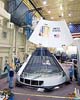
NASA's Constellation Program is making progress toward selecting a prime contractor to design, develop and build the Crew Exploration Vehicle (CEV), America's first new human spacecraft in 30 years. |
|
|

| The content herein, unless otherwise known to be public domain, are Copyright 1995-2006 - SpaceDaily.AFP and UPI Wire Stories are copyright Agence France-Presse and United Press International. ESA PortalReports are copyright European Space Agency. All NASA sourced material is public domain. Additionalcopyrights may apply in whole or part to other bona fide parties. Advertising does not imply endorsement,agreement or approval of any opinions, statements or information provided by SpaceDaily on any Web page published or hosted by SpaceDaily. Privacy Statement |