|
 |
 |
 |
 |
 |
 |
 |
 |

 |
European Probe Sniffs Out A Site For Lunar Outpost
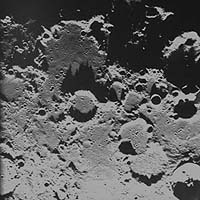
Cambridge, England (AFP) Sep 06, 2005 An experimental European probe has spotted a tiny area on the Moon that could be a promising site to set up a future manned outpost, a mission scientist said here Tuesday. Measuring "just a few square kilometers (miles) across" and located near the Moon's North Pole, the region is bathed in perpetual sunlight, making it an ideal location for solar cells to power a lunar colony, said Bernard Foing of the European Space Agency (ESA). The discovery was made by SMART-1, an instrument-packed probe that is testing revolutionary technology in Europe's first exploration of the Moon. SMART-1, with a mass of just 370 kilos (814 pounds), was launched in September 2003 but took more than 13 months to enter orbit around Earth's satellite, a trip that the Apollo astronauts for more than three decades ago did in only three days. The reason for the snail-like progress is that, unlike the Apollo team, sent aloft by chemical rocket, SMART-1 is powered by an ion engine, a device that converts solar power into electricity, which then charges atoms of the heavy gas xenon. The charged atoms are then disgorged from the back of the box-like spacecraft to give it a tiny bit of thrust, of just five grammes (a fifth of an ounce). The approach works fine in the frictionless environment of space, and is ideal for long unmanned missions where time is not important. Foing, who unveiled SMART-1's discovery at a conference in Cambridge of American and European astronomers, said the probe had also discovered a patch of the Moon that was perpetually dark and never received any sunlight. Contrary to popular belief, the Moon does rotate, but the spin is synchronous with that of Earth's own rotation, which means we only ever see one lunar face, not the so-called "dark side." The lunar axis and obliquity to the Sun mean that there is a location measuring several thousand square kilometers (miles) that is always in the dark, Foing said. SMART-1's next step over the next year will be to test a theory that such a region may harbour water ice. If this is ever confirmed, that too would be an enormous boost for human settlement. The Moon has a reputation, earned from the 1960s, for being utterly dry as well as airless. But there are suspicions that its soil may have secret reserves of ice, locked away in perpetually dark areas or in deep craters near the poles. After decades of being snubbed for space exploration after the Apollo era, the Moon is returning to vogue. It has been helped by the fading interest in orbital missions around Earth, exemplified by the problem-wracked International Space Station and US shuttle. In 2004, US President George W. Bush announced NASA would send astronauts back to the Moon by 2020 as a forerunner for a manned mission to Mars. NASA is reported to be already planning for a lunar outpost that would have living quarters and a power plant. One idea is to search for a mineral called ilmenite, an oxide of iron and titanium that contains oxygen, hydrogen and helium, as well as iron. These elements could be extracted to provide fuel and steel, according to this thinking. Foing said that several other spacecraft had successfully used ion engines, and the design was first preference for a planned ESA probe to explore Mercury and the Sun, pencilled for launch in 2014. Community Email This Article Comment On This Article Related Links SpaceDaily Search SpaceDaily Subscribe To SpaceDaily Express Mars News and Information at MarsDaily.com Lunar Dreams and more
 SMART 1 Uses New Imaging Technique In Lunar Orbit
 Paris, France (ESA) Dec 28, 2005
ESA's SMART-1 spacecraft has been surveying the Moon's surface in visible and near-infrared light using a new technique, never before tried in lunar orbit. |
|
|

| The content herein, unless otherwise known to be public domain, are Copyright 1995-2006 - SpaceDaily.AFP and UPI Wire Stories are copyright Agence France-Presse and United Press International. ESA PortalReports are copyright European Space Agency. All NASA sourced material is public domain. Additionalcopyrights may apply in whole or part to other bona fide parties. Advertising does not imply endorsement,agreement or approval of any opinions, statements or information provided by SpaceDaily on any Web page published or hosted by SpaceDaily. Privacy Statement |