|
 |
 |
 |
 |
 |
 |
 |
 |

 |
Joint Chinese/European Mission Ready For Launch
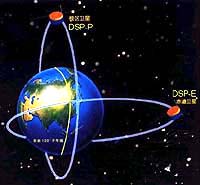
Paris (ESA) Dec 23, 2003 On 27 December, the Chinese National Space Agency (CNSA) will launch the first of two scientific satellites known as Double Star. ESA is contributing to this Double Star mission by providing eight on-board scientific instruments. Double Star follows the footsteps of ESA's Cluster mission and will study closely the interaction between the 'solar wind' and the Earth's magnetic field. In 1997, the CNSA invited ESA to participate in Double Star, a two-satellite mission to study the Earth's magnetic field, from a perspective which is different from that of Cluster but complementary to it. Cluster and Double Star spacecraft will co-ordinate their investigations and help us gain a much better understanding of the processes taking place above Earth. Some of these phenomena are spectacularly beautiful, such as the polar aurorae, but others, like the magnetic storms, can have serious effects on human activities - from power cuts to damaged satellites and communication breakdowns. The positions and orbits of the two Double Star satellites have been carefully chosen to allow the study of the magnetosphere on a larger scale than that possible with Cluster alone. A typical example of how both missions will co-operate is the study of the magnetic substorms producing the bright aurorae. Double Star and Cluster together will address the fundamental question where these substorms start. The Cluster satellites are in a high orbit, about one third of the distance to the Moon, where the mechanisms causing these substorms are thought to begin. The spacecraft are very close to each other, only a few hundred kilometres between them, allowing us to observe small regions in a great detail. However, some scientists suggested that these mechanisms might begin closer to the Earth, so this is why Double Star will be placed in lower orbits. The four Cluster spacecraft are currently passing in and out of the magnetosphere, visiting regions where the interaction with the solar wind is especially important, such as the 'polar cusps' and the 'magnetotail'. The polar cusps are funnel-like openings in the magnetosphere at the poles, and are the 'doors' used by electrically charged particles from the solar wind to descend into Earth's upper atmosphere. The magnetotail is the part of the magnetosphere pushed in the direction of the solar wind - shaped like a giant windsock and stretching at least two million kilometres into space on the night side of the Earth. These regions are difficult to explore and many mysteries remain but Double Star and Cluster will eventually help us to understand more about these phenomena. Community Email This Article Comment On This Article Related Links Double Star at ESA SpaceDaily Search SpaceDaily Subscribe To SpaceDaily Express Solar Science News at SpaceDaily
 Who's Afraid Of A Solar Flare?
 Huntsville AL (SPX) Oct 09, 2005
Last month, the sun went haywire. Almost every day for two weeks in early September, solar flares issued from a giant sunspot named "active region 798/808." X-rays ionized Earth�s upper atmosphere. Solar protons peppered the Moon. It was not a good time to be in space. |
|
|

| The content herein, unless otherwise known to be public domain, are Copyright 1995-2006 - SpaceDaily.AFP and UPI Wire Stories are copyright Agence France-Presse and United Press International. ESA PortalReports are copyright European Space Agency. All NASA sourced material is public domain. Additionalcopyrights may apply in whole or part to other bona fide parties. Advertising does not imply endorsement,agreement or approval of any opinions, statements or information provided by SpaceDaily on any Web page published or hosted by SpaceDaily. Privacy Statement |