|
 |
 |
 |
 |
 |
 |
 |
 |

 |
Europe Waves Soyuz Taxi Away Until Fixed
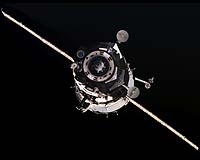
Paris - May 15, 2003 The crew of Expedition 6 to the International Space Station, US astronauts Kenneth Bowersox and Donald Pettit and Russian cosmonaut Nikolai Budarin, returned to Earth on 4 May after spending 162 days on board. Expedition 6 left the ISS in the TMA-1 spacecraft that had flown ESA astronaut Frank De Winne to the Station on 1 November 2002. Initially the Expedition 6 crew was to have been relieved in March by a new crew arriving on Space Shuttle flight STS 114. After the Columbia accident, ESA agreed to a six-month postponement of Pedro Duque's mission to the Station, initially scheduled for April, making the Soyuz flight available for relieving the Expedition 6 crew. The Expedition 7 crew, US astronaut Ed Lu and Russian cosmonaut Yuri Malenchenko, arrived at the Station on a TMA-2 spacecraft on 28 April. The Soyuz capsule's re-entry did not take place in the nominal automatic controlled mode, in which the trajectory of the capsule is actively controlled by using aerodynamic lifting forces when rolling the capsule to the left or right. This mode provides minimum gravity loads to the astronauts during re-entry and accurate landing, which in the case of Expedition 6 should have occurred 88 km north of Arkalyk. For as yet unknown reasons the re-entry took place in ballistic mode, in which the capsule behaves like a spherical object. For greater stability the capsule spins around its trajectory axis. The ballistic mode leads to a steeper trajectory, increased gravity loads for astronauts, and less precision in reaching the landing site. It is a contingency mode, which had occurred twice before in the history of Soyuz capsule re-entries. The Expedition 6 crew experienced about 8 times the force of gravity during re-entry and the landing took place at 04:07 Central European Time, 150 km north of Baikonur, about 440 km short of the planned target landing area. The recovery teams therefore had to be redirected and it took them longer than usual to locate and retrieve the capsule. The crew had established radio communications with the recovery teams and the Mission Control Centre near Moscow. After the arrival of the recovery teams, the crew were flown by helicopter to Baikonur, from where they returned to the Chalkovsky military airfield near the Gagarin Cosmonaut Training Centre in Star City, north of Moscow. Nikolai Budarin, Kenneth Bowersox, and Donald Pettit were in good physical shape. At the Gagarin Cosmonaut Training Centre they have started debriefings and physical rehabilitation, which will last about 16 days. This was the first re-entry by the enhanced TMA-1. It was also the first time that US astronauts had returned from space in a Soyuz spacecraft. The Expedition 7 crew flew TMA-2, the second enhanced Soyuz spacecraft, to the ISS, where it will stay until October/November 2003. It will then be used to bring the Expedition 7 crew and the European astronaut Pedro Duque back to Earth. Rosaviakosmos Director General Yuri Koptev has set up a State Commission under Nikolai Moiseev, Deputy Director General of Rosaviakosmos, to investigate why the Soyuz re-entry occurred in ballistic mode. Community Email This Article Comment On This Article Related Links ESA Human Spaceflight SpaceDaily Search SpaceDaily Subscribe To SpaceDaily Express Space Station News at Space-Travel.Com
 NASA Had No Choice But To Buy Soyuz Flights
 Washington DC (SPX) Jan 09, 2006
NASA's announcement last week that it will pay Roskosmos $43.6 million for a round-trip ride to the International Space Station this spring, and an equivalent figure for an as-yet-undetermined number of future flights to the station until 2012, represents the agency's acknowledgment that it had no alternative. |
|
|

| The content herein, unless otherwise known to be public domain, are Copyright 1995-2006 - SpaceDaily.AFP and UPI Wire Stories are copyright Agence France-Presse and United Press International. ESA PortalReports are copyright European Space Agency. All NASA sourced material is public domain. Additionalcopyrights may apply in whole or part to other bona fide parties. Advertising does not imply endorsement,agreement or approval of any opinions, statements or information provided by SpaceDaily on any Web page published or hosted by SpaceDaily. Privacy Statement |