|
 |
 |
 |
 |
 |
 |
 |
 |

 |
Europe And Asia Must Up Response To Natural Disasters
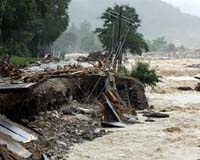
Geneva (AFP) Jan 29, 2007 Asia continues to bear the brunt of the world's natural disasters and the region's economic boom has not yet led to effective response systems, a report said on Monday. Meanwhile, Europe's record on response and prevention is "dismal" given its high level of development, the annual report on natural disasters by the Centre for Research on the Epidemiology of Disasters (CRED) at the University of Louvain in Belgium. In 2006, nearly 400 natural disasters killed 21,342 people, with floods accounting for over half (226) of all occurences, according to figures compiled by the centre. Asia suffered nearly three quarters of the casualties (74.2 percent), followed by Europe with 15.3 percent, Africa 7.5 percent, the Americas 2.9 percent and Oceania 0.1 percent, CRED said in a joint statement with the United Nations office for disaster reduction strategy. "Asia continues to remain a problem area," CRED director Debarati Guha-Sapir told journalists. "This is bad because Asia is an economically booming place and governments do not have a good excuse for not investing in disaster prevention and preparedness," she said. The largest single natural disaster in 2006 was the May earthquake in Indonesia which killed 5,778 people, according to the centre. This was followed by Typhoon Durian in the Philippines in December with 1,399 fatalities, and a February landslide in the same country that claimed 1,112 lives. The next two statistics were from prosperous northern Europe, with July's heatwave claiming 1,000 lives in the Netherlands and 940 lives in neighbouring Belgium. A cold snap in Ukraine in January killed 801 people, taking it into eighth place. "The statistic for Europe is dismal. For such a developed region to be at the top of the list is an unacceptable situation," Guha-Sapir said. "We live in Europe with such a sense of security that we don't realise that disasters can happen," she added. By contrast she highlighted the progress made by Bangladesh, one of the world's poorest countries which suffers regularly from flooding. In 1973, some 150,000 people were killed as a result of floods, but since then the government has taken steps to evacuate people from low-lying areas and install shelters against cyclones, and there are less victims, Guha-Sapir noted.
Source: Agence France-Presse Community Email This Article Comment On This Article Related Links Bring Order To A World Of Disasters Bringing Order To A World Of Disasters A world of storm and tempest When the Earth Quakes
 Repairs To Quake-Hit Asia Internet Cables Delayed Again
 Hong Kong (AFP) Jan 29, 2007
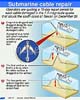
Hong Kong's telecom regulator said Monday bad weather had again delayed full repairs to undersea cables damaged last year by an earthquake, which badly disrupted Internet access in parts of Asia. The Office of the Telecommunications Authority (OFTA) said most of the seven submarine cables, damaged by a powerful 7.1-magnitude temblor off Taiwan on December 26, have now been fixed but that one will take longer than estimated. |
|
|

| The content herein, unless otherwise known to be public domain, are Copyright 1995-2006 - SpaceDaily.AFP and UPI Wire Stories are copyright Agence France-Presse and United Press International. ESA PortalReports are copyright European Space Agency. All NASA sourced material is public domain. Additionalcopyrights may apply in whole or part to other bona fide parties. Advertising does not imply endorsement,agreement or approval of any opinions, statements or information provided by SpaceDaily on any Web page published or hosted by SpaceDaily. Privacy Statement |