|
 |
 |
 |
 |
 |
 |
 |
 |

 |
Europan Ice Domes Could Be First Place To Look For Life
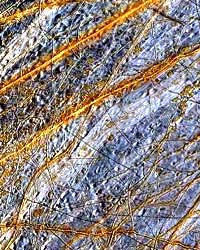
Boulder - Sep 03, 2003 A new University of Colorado at Boulder study of Jupiter's moon Europa may help explain the origin of the giant ice domes peppering its surface and the implications for discovering evidence of past or present life forms there. Assistant Professor Robert Pappalardo and doctoral student Amy Barr previously believed the mysterious domes may be formed by blobs of ice from the interior of the frozen shell that were being pushed upward by thermal upwelling from warmer ice underneath. Europa is believed to harbor an ocean beneath its icy surface. But the scientists now think the dome creation also requires small amounts of impurities, such as sodium chloride or sulfuric acid. Basically the equivalent of table salt or battery acid, these compounds melt ice at low temperatures, allowing warmer, more pristine blobs of ice to force the icy surface up in places, creating the domes. "We have been trying for some time to understand how these ice blobs can push up through the frozen shell of Europa, which is likely about 13 miles thick," said Pappalardo of the astrophysical and planetary sciences department. "Our models now show that a combination of upwelling warm ice in the frozen shell's interior, combined with small amounts of impurities such as sodium chloride or sulfuric acid, would provide enough of a force to form these domes." A paper on the subject co-authored by Pappalardo and Barr was presented at the annual Division of Planetary Sciences Meeting held Sept. 2 through Sept. 6 in Monterey, Calif. DPS is an arm of the American Astronomical Society. Europa appears to have strong tidal action as it elliptically orbits Jupiter - strong enough "to squeeze the moon" and heat its interior, said Pappalardo. "Warm ice blobs rise upward through the ice shell toward the colder surface, melting out saltier regions in their path. The less dense blobs can continue rising all the way to the surface to create the observed domes." The domes are huge - some more than four miles in diameter and 300 feet high - and are found in clusters on Europa's surface, said Barr, who did much of the modeling. "We are excited about our research, because we think it now is possible that any present or past life or even just the chemistry of the ocean may be lifted to the surface, forming these domes. It essentially would be like an elevator ride for microbes." Barr likened the upwelling of warmer ice from the inner ice shell to its surface to a pot of boiling spaghetti sauce. "The burner under the pan sends the hottest sauce to the top, creating the bubbles at the surface," she said. "The trouble is Europa's icy skin is as cold and as hard as a rock." The idea that either small amounts of salt or sulfuric acid might help to create Europa's domes was Pappalardo's, who knew about similar domes on Earth that form in clumps in arid regions. On Earth, it is salt that is buoyant enough to move up through cracks and fissures in rock formations to form dome clusters at the surface. "In addition, infrared and color images taken of Europa by NASA's Galileo spacecraft seem to indicate some of the ice on the surface of these domes is contaminated. Impurities seen at the surface are clues to the internal composition of the Jovian moon, telling of a salty ice shell," he said. "The surface of Europa is constantly being blasted by radiation from Jupiter, which likely precludes any life on the moon's surface," said Barr. "But a spacecraft might be able to detect signs of microbes just under the surface." Both Pappalardo and Barr also are affiliated with CU-Boulder's Laboratory for Atmospheric and Space Physics. The project was funded by NASA's Exobiology Program and Graduate Student Research Program. Pappalardo recently served on a National Research Council panel that reaffirmed a spacecraft should be launched in the coming decade with the goal of orbiting Europa. He currently is part of a NASA team developing goals for the Jupiter Icy Moons Orbiter mission. The scientific objectives of the mission probably will include confirming the presence of an ocean at Europa, remotely measuring the composition of the surface and scouting out potential landing sites for a follow-on lander mission. Community Email This Article Comment On This Article Related Links University Of Colorado, At Boulder SpaceDaily Search SpaceDaily Subscribe To SpaceDaily Express Jupiter and its Moons Explore The Ring World of Saturn and her moons The million outer planets of a star called Sol News Flash at Mercury
 The Moon Eclipses Jupiter
 Huntsville AL (SPX) Nov 30, 2004
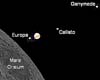
Picture this: You're an astronaut driving a moon buggy across the dusty plains of Mare Crisium. It's nighttime, but not dark. There's a big bright gibbous Earth hanging low behind your back, and it lights up the moonscape, softly, as far as the eye can see. You turn off the headlights and hit the accelerator. |
|
|

| The content herein, unless otherwise known to be public domain, are Copyright 1995-2006 - SpaceDaily.AFP and UPI Wire Stories are copyright Agence France-Presse and United Press International. ESA PortalReports are copyright European Space Agency. All NASA sourced material is public domain. Additionalcopyrights may apply in whole or part to other bona fide parties. Advertising does not imply endorsement,agreement or approval of any opinions, statements or information provided by SpaceDaily on any Web page published or hosted by SpaceDaily. Privacy Statement |