|
 |
 |
 |
 |
 |
 |
 |
 |

 |
Europa Surface Missions Necessary Step In Extraterrestrial Search
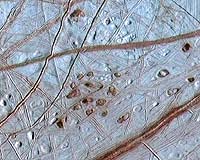
Tempe - Feb 17, 2003 Scientists have long considered Europa, the smallest of the four Galilean moons orbiting Jupiter, as a prime candidate for life outside Earth because it is one of the few places in the solar system where liquid water may be found. Any future Europa exploration should focus on the identification of sites where signs of past or present life can be found and studied, says Ron Greeley, an ASU geology professor. Greeley, who heads up the Europa Astrobiology research at ASU, is co-author of an abstract paper on potential Europa habitats presented at the 2003 NASA Astrobiology Institute General Meeting held Feb. 10 � 12 at ASU. The meeting brought more than 500 researchers from throughout the United States to discuss the latest developments in astrobiology. The NASA Astrobiology Institute includes a multitude of diverse disciplines including chemistry, biology, geology, microscopy and astronomy. Greeley said assuming life arises quickly under appropriate formative conditions, life could be present wherever there is liquid water, a source of energy and essential elements. Europa is roughly the size of the moon, and is believed to have a rocky interior and an outer shell of ice -- and possibly liquid water -- about 60 to 100 miles thick. Scientists say mounting evidence for the existence of a salty liquid ocean beneath Europa's icy crust is exciting because that is just the environment that could provide favorable conditions for present life, or where signs of past life may be preserved. Europa has been studied for years by examining data collected by the unmanned Galileo spacecraft's onboard science instruments, but Greeley and his NASA colleagues believe future studies of Europa will need to focus on surface units, particularly in areas where geologic processes have caused the satellite's icy crust to melt, and where organisms would be protected from radiation and provided with an adequate food supply. "Now that the Galileo mission is nearly completed, it is time for researchers to sift through the images to shape the current state-of-knowledge about the satellite and pose scientific questions to be addressed by future missions," said ASU researcher Patricio Figueredo, Greeley's colleague, and first author of the Europa habitat paper. Although it is not clear to researchers how far a liquid ocean is from the surface, Figueredo says scientists must now piece together the visible evolution history of Europa and determine how different pathways of energy, materials and nutrient interactions would affect possible ecosystems in the satellite. A second paper presented at the conference starts from the idea that a liquid ocean is present on Europa to offer one explanation as to why sulfate is found on the surface of the satellite. Sulfate has been readily observed on Europa's surface by a stereoscopic instrument aboard Galileo. If the sulfate is from a liquid ocean, it is likely to have been formed by high-temperature fluids released at the oceanic floor from the satellite's silicate mantle. When these high-temperature fluids are cooled quickly, it would provide the right conditions to support life, says ASU's Mikhail Zolotov and Everett Shock, geology researchers who presented the paper, "Autotrophic Sulfate Reduction in a Hydrothermally Formed Ocean on Europa." The differentiated internal structure of Europa implies that high temperature interaction of water and rocks occurred at least once in the satellite's history. It is plausible some volcanic activity is also occurring on present day Europa, driven by tidal forces. The authors believe high-temperature fluids from the satellite's rocky core flow into the icy-cold ocean above. Similarly, this phenomenon occurs on Earth, under the ocean floor within mid-ocean ridge volcanoes. These deep-sea hydrothermal vents -- known more commonly as black smokers -- force sulfur-rich, high-temperature water (about 350-degrees Celsius) out onto the ocean floor through chimney-like, volcanic rock structures. As the hot, mineral-rich water rushes out of the chimney and mixes with cold ocean bottom water, it precipitates a variety of minerals as tiny particles that, in turn, provide energy to marine life. When sulfate from seawater mixes with the vent fluid, it can be a source of energy for life through a process called autotrophic sulfate reduction. "On Earth, sulfates can be reduced through biologic activity in oxygen-free sedimentary basins or in organic-rich oceanic sediments," said Shock. "Although the amount of energy on Europa could be insufficient to allow these biologic organisms to persist throughout the ocean's history, a periodic supply of organic compounds or other environmental factors introduced into the ocean could maintain life over time. If this process is detected in the chemical composition of Europa's oceanic water, it would be highly suggestive of the involvement of ancient life." Community Email This Article Comment On This Article Related Links Arizona State University Tempe, Arizona SpaceDaily Search SpaceDaily Subscribe To SpaceDaily Express Life Beyond Earth Lands Beyond Beyond - extra solar planets - news and science
 SETI Sets Its Sights On M Dwarfs
 Moffett Field CA (SPX) Nov 18, 2005
Scientists have been searching actively for signs of intelligent extraterrestrial civilizations for nearly half a century. Their main approach has been to point radio telescopes toward target stars and to "listen" for electronic transmissions from other worlds. |
|
|

| The content herein, unless otherwise known to be public domain, are Copyright 1995-2006 - SpaceDaily.AFP and UPI Wire Stories are copyright Agence France-Presse and United Press International. ESA PortalReports are copyright European Space Agency. All NASA sourced material is public domain. Additionalcopyrights may apply in whole or part to other bona fide parties. Advertising does not imply endorsement,agreement or approval of any opinions, statements or information provided by SpaceDaily on any Web page published or hosted by SpaceDaily. Privacy Statement |