|
 |
 |
 |
 |
 |
 |
 |
 |

 |
Europa Has Right Stuff
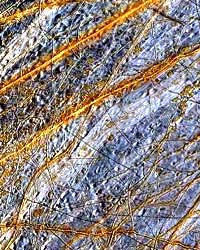
Mountain View - May 23, 2002 Compelling evidence for a liquid water ocean beneath its icy crust makes Jupiter's moon Europa an attractive target for scientists seeking life in distant regions of our solar system. Recent work by Dr. Elisabetta Pierazzo, currently at the Planetary Science Institute, and Dr. Christopher Chyba of the SETI Institute, sheds light on the question of whether enough "biogenic elements," the raw ingredients for life, including carbon, nitrogen, sulfur and phosphorus, could be present to support Europan life. Because Europa's formation conditions are uncertain, scientists do not know the exact composition of the moon's ocean and overlying ice. Some models suggest a Europa depleted of life-essential carbon and other important biogenic chemicals at birth. Pierazzo and Chyba explored comets as an alternate source for biogenic materials, applying complex modeling methods to set the lower limits for a Europan inventory. In the May edition of the journal Icarus, Pierazzo and Chyba present a paper that concludes the Europan inventory to be "substantial." "We now know that enough of the right materials should have been present to support a Europan biosphere," says author Chyba, who in addition to studying Europa, also oversees a broad spectrum of astrobiological research conducted at the SETI Institute's Center for the Study of Life in the Universe. "If these chemicals find their way into the ocean," said Pierazzo, "and if there exists a mechanism that could take them through the formation of increasingly complex organic molecules, those elements could ultimately evolve into living cells." In their model, Pierazzo and Chyba used typical cometary sizes, densities, and impact velocities throughout Solar System history to calculate how much biogenic material would remain on the moon's surface after impact events. Unlike the more massive Earth, which has a much higher escape velocity and can therefore retain a higher percentage of cometary impact material, Europa has a very low escape velocity, thus losing a significant portion of material from any projectile that hits its surface. Earlier studies of cometary impacts on Earth and Mars by the authors suggested substantial amounts of prebiotic chemicals including amino acids would have survived cometary impacts, especially at very low, grazing angles, and thus contributed to the planets' inventories of complex organic materials. While Europan models also predict significant post-impact survival rates for similar impacts, the low escape velocity of the moon would allow the vast majority of this complex organic material to be lost; with the rest of the projectile material, it would disappear in space. Nevertheless, cometary impacts would provide billions of tons of carbon, and somewhat less nitrogen, sulfur and phosphorus to the surface of Europa. These amounts are significant, and correspond to about 1% of the biomass of prokaryotic life (cells lacking nuclei and believed to be representative of early life) in today's Earth oceans. Knowing that, at a minimum, Europa has enough of the elements needed to sustain a biosphere offers further reason for scientists to feel hopeful about the search for extraterrestrial life within our own solar system. Dr. Chyba is the Carl Sagan Chairholder and Director of the Center for the Study of Life in the Universe at the SETI Institute in Mountain View, California, and is also an Associate Professor of Geological and Environmental Sciences at Stanford University in Stanford California. The SETI Institute,a private nonprofit organization dedicated to scientific research, education and public outreach, seeks to explore, understand and explain the origin, nature and prevalence of life in the universe. Dr. Pierazzo is a research scientist at the Planetary Science Institute of Tucson Arizona where her work focuses on impact cratering of planetary surfaces and their effects on the evolution of biospheres. Community Email This Article Comment On This Article Related Links Planetary Science Institute SETI SpaceDaily Search SpaceDaily Subscribe To SpaceDaily Express Life Beyond Earth Lands Beyond Beyond - extra solar planets - news and science
 Latching Onto Lichen
 Moffett Field CA (SPX) Dec 06, 2005
Bacteria can often survive the harsh conditions of space, and their toughness and adaptability have made them key candidates for the transfer of life between planets. But in a recent study by European scientists, lichen survived a trip in space even better than bacteria do. |
|
|

| The content herein, unless otherwise known to be public domain, are Copyright 1995-2006 - SpaceDaily.AFP and UPI Wire Stories are copyright Agence France-Presse and United Press International. ESA PortalReports are copyright European Space Agency. All NASA sourced material is public domain. Additionalcopyrights may apply in whole or part to other bona fide parties. Advertising does not imply endorsement,agreement or approval of any opinions, statements or information provided by SpaceDaily on any Web page published or hosted by SpaceDaily. Privacy Statement |