|
 |
 |
 |
 |
 |
 |
 |
 |

 |
Establishing A Connection Between Global Warming And Hurricane Intensity
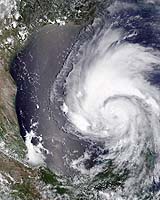
Washington DC (SPX) Aug 16, 2006 Climate change is affecting the intensity of Atlantic hurricanes, and hurricane damage will likely continue to increase because of greenhouse warming, according to a new study. It provides for the first time a direct relationship between climate change and hurricane intensity, unlike other studies that have linked warmer oceans to a likely increase in the number of hurricanes. James Elsner of Florida State University in Tallahassee examined the statistical connection between the average global near-surface air temperature and Atlantic sea surface temperature, comparing the two factors with hurricane intensities over the past 50 years. He found that average air temperatures during hurricane season between June and November are useful in predicting sea surface temperatures--a vital component in nourishing hurricane winds as they strengthen in warm waters--but not vice-versa. Elsner's paper is scheduled to be published 23 August in Geophysical Research Letters, a journal of the American Geophysical Union. Several recent studies have warned that human-induced climate warming has the potential to increase the number of tropical cyclones (hurricanes), and previous research and computer models suggest that hurricane intensity would increase with increasing global mean temperatures. Others, however, hypothesize that the relationship between sea surface temperatures and hurricanes can be attributed to natural causes, such as the Atlantic Multidecadal Oscillation, an ongoing series of long-term changes in the sea surface temperature of the North Atlantic Ocean. "The large increases in powerful hurricanes over the past several decades, together with the results presented here, certainly suggest cause for concern," Elsner said. "These results have serious implications for life and property throughout the Caribbean, Mexico, and portions of the United States." Using highly detailed data from the Intergovernmental Panel on Climate Change (IPCC) and the National Oceanographic and Atmospheric Administration (NOAA) to monitor sea temperature anomalies over the past half-century, Elsner used a causality test to establish evidence in support of the climate change/hurricane intensity hypothesis. His analysis helps provide verification of a linkage between atmospheric warming caused largely by greenhouse gases and the recent upswing in frequency and intensity of Atlantic hurricanes, including Katrina and Rita, which devastated parts of Mississippi, Louisiana, and Texas in 2005. "I infer that future hurricane hazard mitigation efforts should reflect that hurricane damage will continue to increase, in part, due to greenhouse warming," Elsner said. "This research is important to the field of hurricane science by moving the debate away from trend analyses of hurricane counts and toward a physical mechanism that can account for the various observations." Community Email This Article Comment On This Article Related Links American Geophysical Union Bringing Order To A World Of Disasters When the Earth Quakes A world of storm and tempest
 Three Dead Or Missing As Typhoon Approaches Japan
 Tokyo (AFP) Aug 17, 2006
A typhoon churned toward Japan's Pacific coast Thursday with heavy rain and choppy waves, leaving three people including a middle-aged surfer dead or missing, officials said. |
|
|

| The content herein, unless otherwise known to be public domain, are Copyright 1995-2006 - SpaceDaily.AFP and UPI Wire Stories are copyright Agence France-Presse and United Press International. ESA PortalReports are copyright European Space Agency. All NASA sourced material is public domain. Additionalcopyrights may apply in whole or part to other bona fide parties. Advertising does not imply endorsement,agreement or approval of any opinions, statements or information provided by SpaceDaily on any Web page published or hosted by SpaceDaily. Privacy Statement |