|
 |
 |
 |
 |
 |
 |
 |
 |

 |
Esperanza Fire Captured By Aqua Satellite
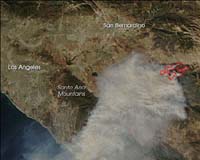
Los Angeles CA (SPX) Oct 31, 2006 Waves of gray-brown smoke washed over the mountains southeast of Los Angeles and out over the Pacific on Oct. 26, 2006, on the same day on which four firefighters were killed fighting the blaze. West of Palm Springs, Calif., the Esperanza Fire had ballooned under the influence of Santa Ana winds to encompass more than 19,000 acres as of the morning of Oct. 27, according to the daily report from the National Interagency Fire Center. Racing through grass, brush, and timber, the blaze had forced hundreds to evacuate, and it killed several firefighters who were working to protect homes. Fire officials are reporting the cause of the blaze as arson. This photo-like image shows the fire and surrounding area captured by the Moderate Resolution Imaging Spectroradiometer (MODIS) on NASA's Aqua satellite on Oct. 26. Places where MODIS detected actively burning fire are outlined in red. The Santa Ana Mountains peak out from beneath the smoke near the southeastern suburbs of Los Angeles. Santa Ana winds are a California firefighter's nightmare. These blustery, dry and often hot winds blow out of the desert and race through canyons and passes in the mountains on their way toward the coast. The air is hot not because it is bringing heat from the desert, but because it is flowing downslope from higher elevations. As fall progresses, cold air begins to sink into the Great Basin deserts to the east of California. As the air piles up at the surface, high pressure builds, and the air begins to flow downslope toward the coast. When winds blow downslope, the air gets compressed, which causes it to warm and dry out. In fact, the air can warm at a rate of 10 degrees Celsius per kilometer of descent (29 degrees Fahrenheit per mile). Canyons and passes funnel the winds, which increases their speed. Not only do the winds spread the fire, but they also dry out vegetation, making it even more flammable. Community Email This Article Comment On This Article Related Links Making money out of watching earth from space today Earth Observation News - Suppiliers, Technology and Application
 A Growing Intelligence Around Earth
 Huntsville AL (SPX) Oct 30, 2006
The Indonesian volcano Talang on the island of Sumatra had been dormant for centuries when, in April 2005, it suddenly rumbled to life. A plume of smoke rose 1000 meters high and nearby villages were covered in ash. Fearing a major eruption, local authorities began evacuating 40,000 people. UN officials, meanwhile, issued a call for help: Volcanologists should begin monitoring Talang at once. |
|
|

| The content herein, unless otherwise known to be public domain, are Copyright 1995-2006 - SpaceDaily.AFP and UPI Wire Stories are copyright Agence France-Presse and United Press International. ESA PortalReports are copyright European Space Agency. All NASA sourced material is public domain. Additionalcopyrights may apply in whole or part to other bona fide parties. Advertising does not imply endorsement,agreement or approval of any opinions, statements or information provided by SpaceDaily on any Web page published or hosted by SpaceDaily. Privacy Statement |