|
 |
 |
 |
 |
 |
 |
 |
 |

 |
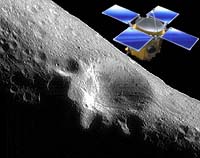
Eros Gets A Look Over
Laurel - April 10, 2000 - NEAR Shoemaker has successfully completed the first phase of its exploration of Eros, focusing on global mapping from an approximately circular 200 km orbit. The spacecraft is now in a transfer orbit that will take it to its next stage of exploration, mapping from 100 km orbit, that will start on April 12. Tucked in amidst the many thousands of images and infrared, x-ray and gamma ray spectra, not to mention the hundred thousands of laser returns, there is another data set garnered in the 200 km orbit that deals with an entirely different aspect of the nature and history of Eros; the magnetic field. NEAR Shoemaker's magnetometer is searching for a magnetic field generated by Eros. So far, no asteroid has been shown conclusively to produce a magnetic field, although there were hints of such fields from the asteroids Gaspra and Ida that were the targets of Galileo flybys in 1992 and 1993 respectively. Many meteorites, which are pieces of asteroids that fall to Earth, are magnetized, having picked up and retained magnetization from their parent bodies. If Eros turns out to have a magnetic field as strong as that of many meteorites, NEAR Shoemaker should detect this field once close enough to the asteroid. Most magnetized objects, when studied from far enough outside their surfaces, have a magnetic field like that of an ordinary bar magnet, forming what is called a "magnetic dipole". A compass needle has such a field, and it has a "north-seeking" pole that points to (magnetic) north on Earth. An arrow that points from the south-seeking pole (S) to the north-seeking pole (N) of a compass needle is aligned with the "magnetic dipole moment" of the needle. This is a quantity with a direction (S to N) and a magnitude defining the strength of the magnetic field (i.e., it is a "vector"). The magnetic fields of the Sun and the Earth have prominent magnetic dipole moments, as well as most of the planets (all but Mars and Venus which have unmeasurably small dipole moments, and Pluto whose dipole moment is unknown). Earth's own magnetic dipole moment is "upside down" -- it points roughly in the direction from geographic north to geographic south. Close to the surface of a magnetized body, it is commonly found that the field is more complex than that of a magnetic dipole, as if there were additional pairs of north-seeking and south-seeking poles on the surface of the body besides the main pair. Ordinary refrigerator magnets, for example, have more complex fields than do simple bar magnets -- often the north-seeking poles and south-seeking poles of a refrigerator magnet are arranged in alternating stripes. This has the effect of concentrating the magnetic field close to the surface where it's needed to cause the magnet to stick to the refrigerator. The magnetic field of Mars turns out to have some similarities -- the main dipole moment of Mars is almost or completely absent, but there are numerous north-seeking and south-seeking poles located in "magnetic stripes" in the southern highlands. The magnetic field strength of a magnetic dipole has the property of decreasing as the inverse cube of the distance from the body (aside from an angular dependence). That is, at twice the distance, the field strength is reduced by 2x2x2 = 8. The field strength at Earth's surface near the equator is about 30000 nanotesla (nT). At one Earth radius above the surface, the field strength has decreased by a factor of 8, and by two radii above the surface (which is three times the distance from the center) the field has decreased by a factor of 27. The magnetic dipole has the property of being the arrangement of magnetic poles that causes magnetic fields to stretch farthest from the body -- any more complex arrangement of poles would cause field strength to decrease even more rapidly away from the planet. This is why NEAR Shoemaker has to orbit close to Eros -- to be able to detect any magnetic field that may be produced. NEAR's magnetometer can detect an external magnetic field of only 1 nT, but Eros would have to be almost as strongly magnetized as the Earth in order to generate a 1 nT field as far away as the 200 km orbit. An Eros surface field of hundreds to thousands of nT, like that of many meteorites, would be detectable only in lower orbits. There are complications of course - the spacecraft itself generates a magnetic field, and the solar wind carries a magnetic field -- but so far, no Eros magnetic field has been detected. Will Eros turn out to be magnetic? We shall see.
Email This Article Comment On This Article Related Links Space
 Satellite Launch To Boost DTH In India
 Calcutta, India (SPX) Dec 28, 2005
The successful launch Thursday of India's heaviest satellite from spaceport of Kourou in French Guyana may have boosted the country's space research efforts to yet another level, but it has also lifted the spirits of at least three Direct-To-Home televisions broadcasters, one of which has been waiting for years to launch its services in India. |
|
|

|
|
|
|
|
|
|
|
|
|
|
|
| The content herein, unless otherwise known to be public domain, are Copyright 1995-2006 - SpaceDaily.AFP and UPI Wire Stories are copyright Agence France-Presse and United Press International. ESA PortalReports are copyright European Space Agency. All NASA sourced material is public domain. Additionalcopyrights may apply in whole or part to other bona fide parties. Advertising does not imply endorsement,agreement or approval of any opinions, statements or information provided by SpaceDaily on any Web page published or hosted by SpaceDaily. Privacy Statement |