|
 |
 |
 |
 |
 |
 |
 |
 |

 |
Eros: Consolidated but Undifferentiated
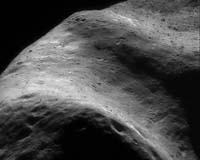
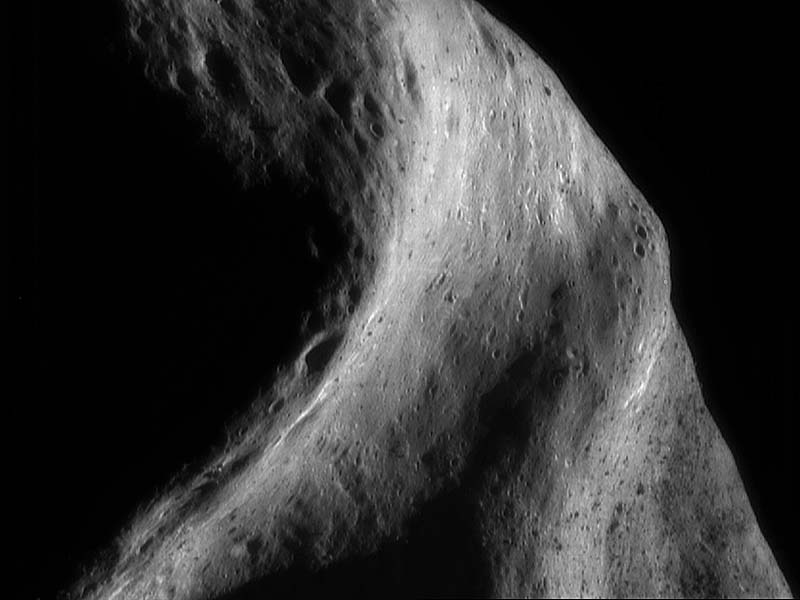
Laurel - October 10, 2000 Will there ever be an Olympics held on an asteroid? Back in the 1950's there were confident predictions that the year 2000 would see permanently inhabited space stations, lunar bases, and manned voyages to the planets. After all, we had just witnessed the developments of television and the atomic bomb, and if we could progress from the first heavier-than-air flying machines to artificial satellites in 54 years, then who knew where we would be in another 50 years? Now that year 2000 is mostly behind us, even manned voyages to other planets are not in prospect for at least the next decade. Holding the Olympics on an asteroid sounds little more realistic now than it would have sounded fifty years ago. But science and technology have continued to move forward at an exponentially increasing rate, and what we are doing in space now, on NEAR, would have been unimaginable fifty years ago. Using a laser to measure topography? - lasers hadn't been invented yet fifty years ago. Measuring the x-ray spectra of an asteroid to confirm that it is linked to primitive meteorites? - this notion would have sounded as crazy to a scientist of fifty years ago as holding the Olympics on an asteroid sounds to us now. At that time, scientists had no reason to expect that asteroids would even be significant sources of x-rays. Science and technology therefore advance in directions that we cannot predict and often do not expect. We are not sending people to other planets, but we are sending instrumented probes to explore new worlds, without sending people. Not that we wouldn't send people if we could - but it costs too much. NEAR, for example, had a total cost, for the entire mission including launch vehicle, spacecraft, and operations, that amounts to $0.80 for each person in the USA, spread over the past seven years. For that money, enough to buy a candy bar if saved over the whole period, NEAR has recorded two principal findings about Eros - that Eros is a primitive, undifferentiated object, and that Eros is a consolidated body as opposed to a rubble pile, meaning a loose agglomeration of much smaller pieces held together mostly by gravity. There are more findings, of course, but they will be our topic for another time. Eros, as an undifferentiated body, is made of material that has been scarcely altered since the beginning of the solar system, and probably since before the formation of the Earth. The relative proportions of rock-forming elements in Eros is similar to those found in the Sun itself. Eros was never subjected to the melting and the separation into compositionally distinct layers that Earth, Mercury, Venus and Mars have all experienced. Eros is made of the same material as certain primitive meteorites, which are pieces of ancient asteroids that have fallen to the surface of the Earth, and which have also never been subjected to melting, although some degree of metamorphism is typical (meaning that these meteorites have been subjected to considerable heating). No rocks form naturally on Earth that are of the same composition as Eros or these meteorites. Even though Eros has about the same overall density as the Earth's crust, NEAR could never mistake a 32.7-km chunk of Earth's crust for Eros. The x-ray spectra would appear totally different. The reason for this difference is that Earth's crust is the outermost layer of a differentiated body. Iron, nickel and other metals (including gold and platinum) were once finely dispersed throughout the primitive material from which Earth formed, but melting occurred early in Earth's history, and these metals settled for the most part into the core of the Earth. Only a small proportion of these metals can still be found in Earth's crust. On Eros, however, these metals would still be present, dispersed throughout the body of the asteroid. There have been serious suggestions that commercial mining of asteroids may someday become viable. While undifferentiated Eros may be 10% metallic nickel-iron by weight (with most of the iron in chemically bound forms), there are also differentiated asteroids, like 1986DA, that are almost pure nickel-iron. NEAR's other principal finding is that Eros appears to be consolidated, meaning that it is held together by material strength. Huge tectonic features are found, which cannot occur in the absence of material strength. Steep slopes are found, where unconsolidated material would be expected to slide off. Many craters have shapes that indicate the influence of material strength in their formation, such as the square craters shown in the image of the day for September 19. Eros has certainly been battered by innumerable impacts, but it has not been battered into a rubble pile. This finding is of interest because it constrains the collisional history of Eros, but someday it may also be interest if we ever discover an asteroid that is on a collision course with Earth. If we decide to deflect such an asteroid, we surely need to know if it is a loose pile of rubble, ready to come apart with little provocation. Breaking such an asteroid into many pieces, most of which are still heading for Earth, would be disastrous. But surely we would send an instrumented probe first, before committing to a particular means of dealing with a rogue asteroid - provided that we had enough time. NASA is funding small programs to search the skies for near-Earth asteroids, and other countries are considering such programs. There is no known asteroid at this time that is on a collision course with Earth, but the next asteroid impact with enough explosive force to threaten the future of civilization is likely to occur within 100,000 years. Eros itself may strike the Earth millions of years from now, or it may not - we cannot say for certain. Perhaps we need to do more to learn about near-Earth asteroids and to make sure we have enough warning time before the next large asteroid impact. It may even allow us someday to hold the Olympics on an asteroid. Community Email This Article Comment On This Article Related Links NEAR Mission Center SpaceDaily Search SpaceDaily Subscribe To SpaceDaily Express Nuclear Space Technology at Space-Travel.com
 Eros Space Science Begins To Take Shape
 Cameron Park - August 20, 2001
The "NEAR" spacecraft has just completed a highly successful mission providing us with our first prolonged and close up view of an asteroid. |
|
|

|
|
|
|
|
|
|
|
|
|
|
|
| The content herein, unless otherwise known to be public domain, are Copyright 1995-2006 - SpaceDaily.AFP and UPI Wire Stories are copyright Agence France-Presse and United Press International. ESA PortalReports are copyright European Space Agency. All NASA sourced material is public domain. Additionalcopyrights may apply in whole or part to other bona fide parties. Advertising does not imply endorsement,agreement or approval of any opinions, statements or information provided by SpaceDaily on any Web page published or hosted by SpaceDaily. Privacy Statement |