|
 |
 |
 |
 |
 |
 |
 |
 |

 |
Environmental Lessons From Tsunami As World's Coastal Population Doubles
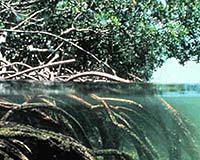
Norwich, UK (SPX) Aug 12, 2005 Coastal populations and ecosystems are more likely to bounce back from extreme coastal disasters by protecting local environments and building on local knowledge, according to a report published in Science. And the aftermath of the Asian tsunami has given valuable insight into handling extreme coastal disasters - inevitable as the world's coastal population is set to double by 2030 and global warming continues to exacerbate extreme weather conditions. The research team from Australia, US, Sweden and UK, led by Dr Neil Adger of the University of East Anglia, is calling for action that builds on the existing resilience of coastal environments and communities when setting up disaster management policies to cope with cyclones, hurricanes, tsunamis and floods. The Social-Ecological Resilience to Coastal Disasters report concludes that healthy ecosystems are much more likely to absorb the shock and provide protection from a coastal disaster than man-made structures such as sea walls or artificial reefs. Globally 23 per cent of the world's population (1.2 billion people) live within 100 km of the coast and this figure is likely to increase to 50 per cent in the next twenty five years as people flock to coastal cities - many these being Asian cities. To compound this, many weather-related disasters are becoming more destructive and intense due to climate change. The report is based on two case studies - the Asian tsunami in 2004 and the impact of severe storms in the Caribbean over the past twenty years. The tsunami had less impact in areas where ecosystems were protected and local communities were aware of coastal hazards than those places where development went right up to the coastline. Sand dunes, mangrove forests and coral reefs helped reduce the energy of tsunami waves in Sri Lanka by acting as natural barriers, the Stockholm Environment Institute discovered in a rapid assessment of the environmental impact of the tsunami. In the Caribbean, the Cayman Islands have adapted to major hurricanes. The government took positive action and educated communities following two major hurricanes in 1988 and 1998 and were much more able to adapt, cope and recover from Hurricane Ivan in 2004. Traditional farming systems which integrated coffee with maize in Honduras were much better at recovering from Hurricane Mitch in 1998 than farming systems which solely grew coffee. Dr Adger, of the Tyndall Centre at UEA, argues that maintaining resilience is the key. New scientific insights from ecologists show that natural ecosystems such as coral reefs and coastal mangrove forests can adapt to change and recover from storms and floods and still provide services of protecting the coast and absorbing pollution. But once these ecosystems are put under pressure by coastal development, they may lose their resilience. Similarly, if communities are more resilient they are going to be able to learn from past experience and to deal with disasters better and to recover quickly. Dr Neil Adger co author of the report said: "If we protect our coastal environment, it will protect us in times of disaster. This now appears to be true for some areas of Asia affected by the tsunami. And it will certainly be true for coasts of the future." Community Email This Article Comment On This Article Related Links University of East Anglia SpaceDaily Search SpaceDaily Subscribe To SpaceDaily Express Tectonic Science and News
 UN Criticises India Refusal To Share Data On Low Magnitude Quakes
 Hyderabad, India (AFP) Dec 16, 2005
India said Friday it would not share information on earthquakes below a magnitude of six on the Richter scale due to security concerns, drawing criticism from the United Nations. |
|
|

| The content herein, unless otherwise known to be public domain, are Copyright 1995-2006 - SpaceDaily.AFP and UPI Wire Stories are copyright Agence France-Presse and United Press International. ESA PortalReports are copyright European Space Agency. All NASA sourced material is public domain. Additionalcopyrights may apply in whole or part to other bona fide parties. Advertising does not imply endorsement,agreement or approval of any opinions, statements or information provided by SpaceDaily on any Web page published or hosted by SpaceDaily. Privacy Statement |