|
 |
 |
 |
 |
 |
 |
 |
 |

 |
Ensemble Combat Suit Keeps Out Toxic Agents, Allows Sweat To Escape
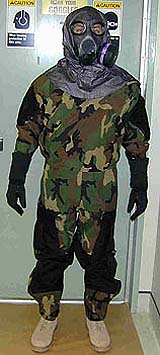
Natick MA (SPX) Nov 22, 2005 Thin is in with the latest technology to protect Special Operations Forces from chemical and biological warfare agents. Selectively-permeable membranes, which look like plastic wrap, block the harmful stuff while allowing sweat to escape without most of the disadvantages of carbon traditionally used for chemical-biological protective garments. Wearing a chemical-biological suit is never pleasant, but those who have tried the new All Purpose-Personal Protective Ensemble with selectively permeable membranes like it better than the alternatives, said Karen Burke, project officer for the ensemble at the Natick Soldier Center's Special Operations Forces Special Projects Team. The new ensemble was approved for production in April and deliveries are scheduled to begin in December. "It's exciting to see it getting used by the folks who need it," Burke said. "What's neat is that this is only the beginning. The 'one-suit-fits-all' philosophy doesn't work anymore. You can tailor it to fit specific requirements of different missions." The drab green ensemble consists of an attached or separate hood, one-piece overgarment with reinforced knees, elbows and seat, and socks. Gloves are a carryover from the existing joint service lightweight integrated suit technology that's the current protective suit for the military. Eight sizes from small to double-extra large are available with leg gussets, Velcro and zippers to further adjust fit because one drawback with chemical-biological protective material is that it does not stretch, Burke said. The ensemble material passed live-agent testing, and prototype suits were tested with simulated agents before getting approval. Testing showed increased protection, but one quality still unknown is wear time. "If we can figure out what features lengthen or shorten its life, then we can reduce its cost," Burke said. She said the Department of Homeland Security is interested in adopting a version of the suit, and services now using the joint service lightweight integrated suit technology may eventually see a selectively permeable membrane ensemble in their inventories as cost decreases, and its performance and long-term durability is proven. "The design is driven by barrier technology," Burke said. "What really makes it work are the closures. To get the full benefit, you have to get high-integrity closures." Joint service lightweight integrated suit technology protects by adsorbing and neutralizing toxic agents with a material containing carbon spheres. The new ensemble is the first garment that seals out contaminants with a membrane protected on each side that has a nylon material laminated onto it, according to Burke. It doesn't wear out with exposure to the atmosphere like carbon-based materials, and Burke said the membrane ensembles indicated in accelerated aging tests that they have a longer shelf life in storage. Selectively permeable membranes in testing proved to be liquid-proof and protect better after contact with a toxic agent, and because they don't adsorb various everyday contaminants, the new ensemble suffers less degradation. The new materials also were more resistant to aerosol, liquid and solid agents for improved protection, according to Burke, and because the new technology is usually thinner and lighter than a comparable adsorptive material, the garment is lighter, leaner and less of a burden to wear. Community Email This Article Comment On This Article Related Links SpaceDaily Search SpaceDaily Subscribe To SpaceDaily Express Space Technology News - Applications and Research
 NGC Chosen To Proceed With Developing Solid-State Laser Technology For Military Applications
 Redondo Beach CA (SPX) Jan 09, 2006
Northrop Grumman Corporation has been selected to develop "military-grade," solid-state laser technology that is expected to pave the way for the U.S. military to incorporate high-energy laser systems across all services, including ships, manned and unmanned aircraft, and ground vehicles. |
|
|

| The content herein, unless otherwise known to be public domain, are Copyright 1995-2006 - SpaceDaily.AFP and UPI Wire Stories are copyright Agence France-Presse and United Press International. ESA PortalReports are copyright European Space Agency. All NASA sourced material is public domain. Additionalcopyrights may apply in whole or part to other bona fide parties. Advertising does not imply endorsement,agreement or approval of any opinions, statements or information provided by SpaceDaily on any Web page published or hosted by SpaceDaily. Privacy Statement |