|
 |
 |
 |
 |
 |
 |
 |
 |

 |
Engineers Visualize Electric Memory As It Fades
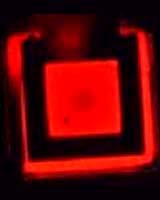
Madison WI (SPX) Jun 02, 2004 While the memory inside electronic devices may often be more reliable than that of humans, it, too, can worsen over time. Now a team of scientists from the University of Wisconsin-Madison and Argonne National Laboratory may understand why. The results were published in the early online edition (May 23) of the journal Nature Materials. Smart cards, buzzers inside watches and even ultrasound machines all take advantage of ferroelectrics, a family of materials that can retain information, as well as transform electrical pulses into auditory or optical signals, or vice versa. "The neat thing about these materials is that they have built-in electronic memory that doesn't require any power," explains Paul Evans, a UW-Madison assistant professor of materials science and engineering, and a co-author of the recent paper. But there's a problem preventing many of these materials from being used more widely in other technologies, including computers. As Evans says, "Eventually they quit working." The ability of ferroelectrics to store information resides in their arrangement of atoms, with each structure holding a bit of information. This information changes every time the material receives a pulse of electricity, basically switching the arrangement of atoms. However, each electric pulse - and corresponding change in structure - gradually diminishes the capability of these materials to store and retrieve information until they either forget the information or quit switching altogether. "It could switch 10,000 or even millions of times and then stop working," says Evans. Engineers call this problem fatigue. With little evidence for what happens to the structure of ferroelectrics as the material's memory fatigues, Evans and his colleagues decided to look inside this material as its arrangement of atoms, controlled by electrical pulses, switched inside an operating device. "We'd like to understand how it switches so we could build something that switches faster and lasts longer before it wears out," says Evans. To create a detailed picture of how the atoms rearrange themselves inside an operating device during each electrical pulse, the researchers used the Advanced Photon Source - the country's most brilliant source of X-rays for research, located at the Argonne National Laboratory - to measure changes in the location of atoms. By seeing how the atoms changed their positions, the researchers could determine how well the material switched, or remembered information. "One advantage to working with X-rays is their ability to penetrate deep into materials, which is why they are so extensively used today in medical imaging," says Eric Isaacs, director of Argonne's Center for Nanoscale Materials, and one of the paper's co-authors. "Utilizing this property of X-rays, [we] were able to peer through layers of metal electrodes in order to study ferroelectric fatigue in a realistic operating device." He adds that the very high brightness of the Advanced Photon Source allowed the researchers to focus X-rays to unprecedented small dimensions. The X-rays showed that, as the researchers repeatedly pulsed the device, progressively larger areas of the device ceased working, suggesting that the atoms were switching structures less and less. "After 50,000 switches, the atoms were stuck - they couldn't switch anymore," says Evans, adding that a stronger electrical charge did put the atoms back in motion. When the researchers used a higher voltage of electricity from the beginning, switching stopped 100 times later, as reported in the paper. And, in this instance, applying an even stronger pulse made no difference. "With higher voltages, the material can't switch because something has changed about the material itself," says Evans. "When you use bigger voltages, it's not just the switching that stops working, but something even more fundamental." Because previous researchers have not peeked inside working ferroelectric materials to understand their arrangement of atoms - key to the ability to recall information - the reasons why switching eventually stops had not been clearly identified. "The electronic memory is stored in the structure of atoms, and that's why it's so important to see what the structure looks like," explains Evans. By looking inside these devices, he says engineers can begin to understand why the atoms stop switching and then manufacturers can start to design better devices. With this promise, Evans asks, "Wouldn't it be nice to have a computer that doesn't forget what it's doing when you turn it off?" Other researchers involved in the work include Chang Beom Eom, Dong Min Kim and the paper's first author, Dal-Hyun Do, from UW-Madison; and Eric Dufresne, from the University of Michigan. Community Email This Article Comment On This Article Related Links Department of MSE at UWM Argonne National Laboratory Advanced Photon Source at ANL SpaceDaily Search SpaceDaily Subscribe To SpaceDaily Express Space Technology News - Applications and Research
 Industry Team Achieve New Communications Technology With AESA Radars
 Baltimore MD (SPX) Jan 12, 2006
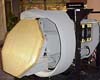
A team comprised of three leading US aerospace and defense contractors has demonstrated an innovative technological use of active electronically scanned array (AESA) radars for high-bandwidth communications. |
|
|

| The content herein, unless otherwise known to be public domain, are Copyright 1995-2006 - SpaceDaily.AFP and UPI Wire Stories are copyright Agence France-Presse and United Press International. ESA PortalReports are copyright European Space Agency. All NASA sourced material is public domain. Additionalcopyrights may apply in whole or part to other bona fide parties. Advertising does not imply endorsement,agreement or approval of any opinions, statements or information provided by SpaceDaily on any Web page published or hosted by SpaceDaily. Privacy Statement |