|
 |
 |
 |
 |
 |
 |
 |
 |

 |
Engineers Test Houses With Cannons, Cranes And Wind Machines
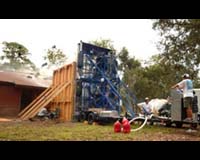
Gainesville FL (SPX) Jun 22, 2006 The wind roared against the house. Shingles and tar paper flew off the roof, exposing bare plywood. The front window buckled, then shattered, shooting glass shards into the living room. The 1970s-style vacant ranch house was taking a beating, but not from a hurricane. Instead, engineers were simulating the effects of hurricane-force winds and wind-driven rain with a custom-built wind machine called the "Wall of Wind." Two caged airboat propellers, each driven by earsplitting Chevrolet V8 502 motors, blasted the house with 120-mph gusts and sheets of water. It was just one of several experiments earlier this month on 10 vacant homes in rural Polk County. The goal: To learn more about why most of Florida's homes - those built before the state's hurricane building code went into effect - buckle under hurricane-force winds. And to test the various methods for fortifying weak points, from reinforcing garage doors to protecting windows with plywood or other coverings. "What we're trying to do is evaluate how much we can reduce an older home's vulnerability by applying post-construction retrofits," said Kurt Gurley, lead researcher on the state-funded project and an associate professor of civil engineering at the University of Florida. Although some counties have had their own building codes for decades, Florida adopted its first statewide building code in 1994, two years after Hurricane Andrew devastated South Florida. The state significantly upgraded that code in 2001, strengthening provisions aimed at preventing hurricane wind damage. Previous research by Gurley and his colleagues has shown that homes built under the most recent code stood up to the four 2004 hurricanes better than those built under the first code. The problem, Gurley said, is that the majority of existing homes were built before 1992. In regions developed early, such as Tampa and St. Petersburg, nearly all the homes in many neighborhoods precede the statewide code. Gurley said that raises two questions: How well do these homes resist hurricane winds, and which of many possible retrofits make the most sense for homeowners seeking to fortify them? "We want to quantify how much you reduce your vulnerability to wind with the various retrofits so that people can weigh the options," Gurley said. "Some homeowners will have limited budgets, so we hopefully we'll come up with a way for them to prioritize." Engineers have extensively tested building components and retrofits, but the work is usually done in labs, Gurley said. That means that while the results may have merit, they don't necessarily match field conditions, where rusted nails, rotted wood and other conditions frequently complicate matters. "That's about the most important thing: We're working in real conditions, capturing data from real houses," said Forrest Masters, an assistant professor of civil engineering and director of the Laboratory for Wind Engineering Research at the International Hurricane Research Center at Florida International University. The 10 Polk County homes, built in the 1970s and 1980s, are typical for modest homes of their era. Their walls are concrete block, with aluminum frame windows and wood truss frame roofs. The engineers had access to the homes because they had flooded extensively and were bought through a state-federal buyout program for vulnerable properties. Besides the wind tests, the researchers used a trailer-mounted air cannon to fire two-by-four boards at one home's windows covered with Lexan, a Plexiglas-like material that can be used for shutters. The test was meant to stimulate flying debris in storms, a common source of damage in heavily populated areas that occurs as homes come apart in storms. A radar gun clocked the two-by-four at 40 mph as it slammed into the Lexan. The Lexan withstood the blow, but it flexed inward several inches, causing the glass window it was protecting to shatter. More important than the loss of a window, the protective cover stayed in place, preventing wind and rain from entering the house, researchers said. To test the strength of roof-to-wall connections against major uplift wind forces on the roof, the engineers used a crane to yank up on the edge of one roof. Rather than snap at the metal connection between the rafters and concrete block, the force cracked off the concrete beam at the wall. In newer homes, that beam is connected to the wall with steel rods, but homeowners of older homes can anchor the beam with a metal strap, researchers said. UF, FIU, Florida A&M University, the University of Western Ontario and the nonprofit Tampa-based Institute of Business and Home Safety are collaborating on the project, funded with a $190,000 grant from the Florida Department of Community Affairs. Community Email This Article Comment On This Article Related Links University Florida Bringing Order To A World Of Disasters A world of storm and tempest When the Earth Quakes
 Two Feared Drowned As Philippines Braces For Deadly Storm-Volcano Combination
 Manila (AFP) Jun 25, 2006
The Philippines Sunday put civil defense personnel on alert for possible deadly volcanic mudflows as a tropical storm began bearing down on a volcano that has been spitting ash for weeks. |
|
|

| The content herein, unless otherwise known to be public domain, are Copyright 1995-2006 - SpaceDaily.AFP and UPI Wire Stories are copyright Agence France-Presse and United Press International. ESA PortalReports are copyright European Space Agency. All NASA sourced material is public domain. Additionalcopyrights may apply in whole or part to other bona fide parties. Advertising does not imply endorsement,agreement or approval of any opinions, statements or information provided by SpaceDaily on any Web page published or hosted by SpaceDaily. Privacy Statement |