|
 |
 |
 |
 |
 |
 |
 |
 |

 |
Engineers Recognise Australian Satellite Achievement
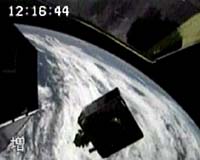
Canberra - Sep 12, 2003 If everything had gone according to plan, Australia's FedSat satellite project would have been a stunning engineering achievement. That it succeeded despite the collapse of its foreign prime contractor made the achievement even more remarkable. Left with little more than an incomplete shell, unassembled pieces and unfinished software, the engineering team from the Cooperative Research Centre for Satellite Systems hastily revised their plans. Instead of having the satellite bus (its structural framework of solar cells, power and control systems) completed in Britain, the team relocated to Canberra, taking the pieces with them. And instead of facing only the difficult enough tasks of integrating the satellite's four complex payloads with the structure, and testing the completed satellite, the team was now confronted with the need to first complete the platform, while simultaneously dealing with increased project costs and the rapidly-approaching launch deadline. Winning an AusIndustry Innovations Access grant was an important step towards the project overcoming these problems. Drawing on the combined resources of its twelve participating organisations, the Centre for Satellite Systems assembled a fifteen-strong team of predominantly young and inexperienced engineers � many still at university � under the supervision of two senior engineers with extensive experience in space projects. Training and education are among the key ambitions of the Cooperative Research Centres (CRC) Program, and along with helping to develop Australian space industry were the primary purposes of the CRC for Satellite Systems. Successful space missions require a combination of ingenuity, high standards of work, and the application of sound engineering practice and principles. Satellites have to operate for years, in a harsh environment and without the possibility of maintenance. For that reason, the FedSat team emphasised high standards of quality control, documentation and test procedures. The outcomes of this careful systems engineering are the 14 December 2002 launch and the operation since then of Australia's most successful and complex satellite to date. World-class engineering excellence, confirmed in the harshest of environments, and inspiring a new generation of engineers to cultivate the highest ambitions � these are the lasting results of the FedSat satellite project. The Cooperative Research Centre for Satellite Systems' success with FedSat was recognised last week by an Engineering Excellence Award of the Canberra Division, The Institution of Engineers, Australia. The project will compete in the national awards later this year. Community Email This Article Comment On This Article Related Links Cooperative Research Centre for Satellite Systems SpaceDaily Search SpaceDaily Subscribe To SpaceDaily Express Space Technology News - Applications and Research
 Industry Team Achieve New Communications Technology With AESA Radars
 Baltimore MD (SPX) Jan 12, 2006
A team comprised of three leading US aerospace and defense contractors has demonstrated an innovative technological use of active electronically scanned array (AESA) radars for high-bandwidth communications. |
|
|

| The content herein, unless otherwise known to be public domain, are Copyright 1995-2006 - SpaceDaily.AFP and UPI Wire Stories are copyright Agence France-Presse and United Press International. ESA PortalReports are copyright European Space Agency. All NASA sourced material is public domain. Additionalcopyrights may apply in whole or part to other bona fide parties. Advertising does not imply endorsement,agreement or approval of any opinions, statements or information provided by SpaceDaily on any Web page published or hosted by SpaceDaily. Privacy Statement |